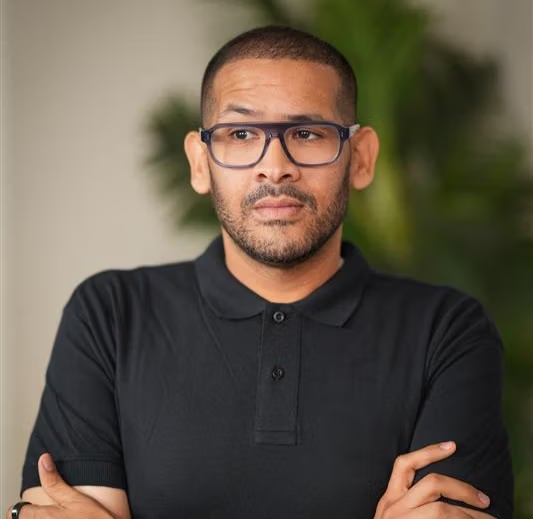
In an industry dominated by algorithms, models, and interfaces, Jamil Shinawi is focused on something far more tangible. The founder and CEO of AHOY is building artificial intelligence that operates not just in digital environments, but in the physical world.
The idea emerged from a practical problem. While developing orchestration systems for disaster response, Shinawi found himself constrained by the absence of tools capable of handling real-time, large-scale coordination. The gap was not technical in nature, but structural. Systems that could move resources, manage logistics, and operate reliably under pressure simply had not been prioritized.
That insight became the foundation of AHOY. The company has since positioned itself around what Shinawi describes as “sovereign physical AI,” an intelligence layer designed to connect, coordinate, and execute across real-world systems. Rather than focusing solely on analysis, the platform is built to act, embedding decision-making directly into operations.
This distinction places AHOY in a different category from much of the current AI landscape. While large language models have captured global attention, Shinawi’s approach reflects a shift toward execution, where intelligence is measured not by what it can generate but by what it can do.
The UAE has played a central role in that journey. Although AHOY operates as a decentralized multinational with teams across multiple markets, the country has become a key base for its operations. For Shinawi, the appeal lies in the pace and mindset of the ecosystem. It is a market where urgency is understood, and where engagement with both policymakers and entrepreneurs can happen within the same week.
That environment has proved particularly suited to a company working at the intersection of technology and infrastructure. Deploying AI at scale, especially in critical systems, requires not only innovation but also access, trust, and alignment with national priorities.
Building that trust has not been immediate. In a region where relationships often precede transactions, AHOY initially faced the challenge of gaining entry into the right conversations. The technology, Shinawi notes, was not the limiting factor. Access was. Over time, consistent delivery on smaller engagements helped establish credibility, allowing the company to expand into more complex and mission-critical deployments.
What sets AHOY apart is not just its positioning but also its approach to growth. In contrast to many technology startups, the company has scaled without relying heavily on external funding. It has crossed $100 million in annual recurring revenue while maintaining profitability, supported by a partnership-driven model that prioritizes distribution and trust over rapid capital deployment.
The strategy reflects a broader philosophy. Rather than chasing scale through investment, Shinawi has focused on building systems that deliver immediate, measurable value. Each contract, each deployment, reinforces the company’s position within a category that is still being defined.
Internally, that clarity extends to leadership. Shinawi describes his approach as setting high standards while maintaining minimal interference. In a multicultural organization, he sees diversity not as a challenge to manage, but as an advantage to enable. The role of leadership, in his view, is to provide direction and then step aside.
Looking ahead, the company is entering a new phase. Expansion into North America is underway, with Europe and Asia already in motion. At the same time, AHOY is deepening its presence in areas such as emergency response and national AI programs, where the need for real-time coordination is most acute.
For Shinawi, the opportunity is not incremental. It is foundational. As artificial intelligence moves from experimentation to deployment, the ability to operate in the physical world is likely to become a defining factor. Systems that can coordinate infrastructure, manage complexity, and execute at scale will shape the next phase of the technology’s evolution.
His advice to entrepreneurs reflects that same emphasis on substance over narrative. In a market like the UAE, he argues, credibility is built through delivery, not presentation. Ideas matter, but execution matters more.
AHOY’s trajectory suggests that the future of AI may not be defined solely by advances in models, but by how effectively those models are translated into action. In that transition, Shinawi is positioning his company not just as a participant, but as a builder of the underlying layer on which that future will operate.