

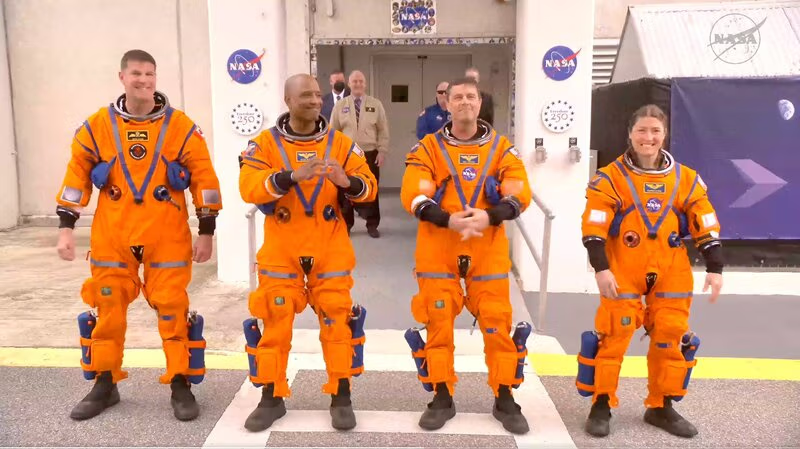
The Artemis II mission marked a milestone in modern space exploration as NASA’s crewed Orion spacecraft returned safely to Earth after completing a historic journey around the moon, the first such voyage by humans in more than five decades.
The capsule, developed by Lockheed Martin and named Integrity, re-entered Earth’s atmosphere and splashed down in the Pacific Ocean off the California coast on Friday, bringing to a close a nearly 10-day mission that pushed astronauts farther into space than any crew since the Apollo era.
Carrying four astronauts from NASA and the Canadian Space Agency, the mission traveled a total of more than 694,000 miles, including a close lunar flyby that took the crew roughly 4,000 miles from the moon’s surface. At its peak, the spacecraft reached a distance of over 252,000 miles from Earth, setting a new benchmark for human spaceflight.
The return journey provided one of the most critical tests of the Orion spacecraft, particularly its heat shield, which endured extreme conditions as the capsule re-entered the atmosphere at speeds exceeding 30 times the speed of sound. Temperatures around the vehicle climbed to nearly 5,000 degrees Fahrenheit, generating a plasma sheath that temporarily cut off communications during the most intense phase of descent.
Contact was restored shortly after the blackout, and a sequence of parachutes slowed the capsule’s descent before it touched down in calm waters. Recovery teams from the U.S. Navy secured the spacecraft and safely retrieved the crew, who were then flown to a nearby naval vessel for initial medical checks.
Mission commander Reid Wiseman, along with fellow astronauts Victor Glover and Christina Koch, and Canadian astronaut Jeremy Hansen, completed the mission in good condition. The flight also carried symbolic significance, with Glover, Koch, and Hansen representing the first Black astronaut, first woman, and first non-U.S. astronaut, respectively, to participate in a lunar mission.
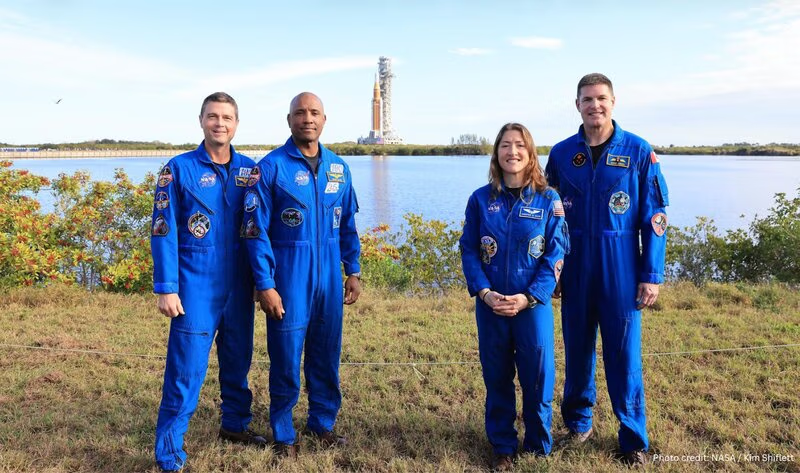
Launched from Cape Canaveral on April 1 aboard NASA’s Space Launch System rocket, Artemis II served as the first crewed test flight in the agency’s broader Artemis program. The mission builds on the uncrewed Artemis I flight in 2022 and is designed to validate systems needed for future lunar landings.
NASA’s long-term objective is to return astronauts to the lunar surface later this decade, with Artemis III expected to attempt a landing, followed by efforts to establish a sustained human presence on and around the moon. The program is also seen as a stepping stone toward eventual crewed missions to Mars.
The successful completion of Artemis II provides critical validation for both the Orion spacecraft and the Space Launch System, which have been in development for more than a decade. It also comes at a time when global interest in lunar exploration is intensifying, with multiple nations, including China, advancing their own ambitions to send astronauts to the moon.
For NASA, the mission represents both a technical achievement and a strategic signal that human deep-space exploration is entering a new phase. The focus now shifts to upcoming missions that will test docking systems, lunar landers, and ultimately the feasibility of sustained operations beyond Earth orbit.