

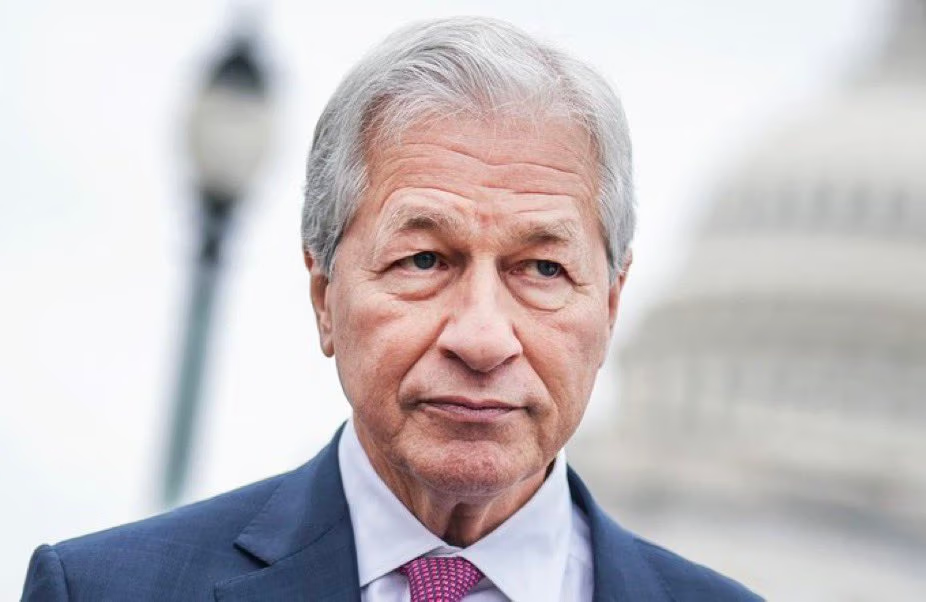
Jamie Dimon’s global markets outlook has sharpened the debate over whether investors are underpricing risks, even as financial markets continue to show resilience despite mounting geopolitical and macroeconomic pressures.
The chief executive of JPMorgan Chase has warned that a combination of factors, including persistent inflation, geopolitical tensions, and vulnerabilities in credit markets, could challenge the current stability seen across equities and fixed income.
Today Jamie Dimon released his annual letter to shareholders—highlighting what he sees as the two anchors of JPMorganChase’s long-term success: running a great company and helping strengthen the long-term health of America and the free world, amid geopolitical conflict and… pic.twitter.com/tYCYNfPTC5
— J.P. Morgan (@jpmorgan) April 6, 2026
At the center of his concern is the risk that inflation may prove more durable than expected. While price pressures have eased from recent peaks, they remain above target in several major economies. Dimon has cautioned that developments such as conflict-driven energy shocks could reverse recent progress, pushing inflation higher and forcing central banks to maintain or even tighten policy.
This dynamic is closely tied to energy markets. Escalation in key regions, particularly the Middle East, could disrupt oil supply routes, which in turn could drive crude prices higher. That sequence, higher energy costs feeding into broader inflation, could complicate the path for interest rates and weigh on growth expectations.
Another area of concern is the rapid expansion of private credit markets, which have grown into a significant segment of global finance. Dimon has flagged risks around weaker underwriting standards and limited transparency, warning that stress in this segment could emerge if economic conditions deteriorate or borrowing costs remain elevated.
Markets, however, have continued to trade with relative confidence. Equity valuations remain supported by strong corporate earnings and expectations that monetary policy may eventually ease. Bond yields have stabilized after a period of volatility, suggesting that investors are pricing in a more benign inflation and rate outlook.
The tension between these two narratives, market optimism and underlying risk, defines the current environment. If Dimon’s concerns materialize, the implications could be far-reaching. Equities could face downward pressure as earnings expectations adjust and discount rates remain elevated. Fixed income markets could see renewed volatility if inflation expectations shift, while credit conditions may tighten, particularly in higher-risk segments.
Currency markets and emerging economies could also be affected, as shifts in global liquidity and interest rate differentials tend to drive capital flows. In such a scenario, markets that have benefited from stable funding conditions may come under pressure.
At the same time, Dimon’s outlook is not entirely pessimistic. He has pointed to structural strengths in the global economy, including continued investment in technology and artificial intelligence, which could support productivity and long-term growth. These factors provide a counterbalance to near-term risks, suggesting that any market adjustment may be uneven rather than systemic.
The broader takeaway is that markets are navigating a period where multiple forces are pulling in different directions. While current pricing reflects a degree of confidence, the range of possible outcomes remains wide.
If Dimon is right, the adjustment may not be immediate, but when it comes, it could reshape expectations across asset classes. For investors, the challenge lies in distinguishing between short-term stability and longer-term risk, and in assessing whether current valuations fully reflect the uncertainties ahead.