
The UAE economy has started 2026 on a firm footing, with multiple indicators pointing to sustained expansion across banking, trade, and investment. The early months of the year reflect not just cyclical recovery but a deeper structural strength that continues to position the country as one of the most resilient and adaptive economies globally.
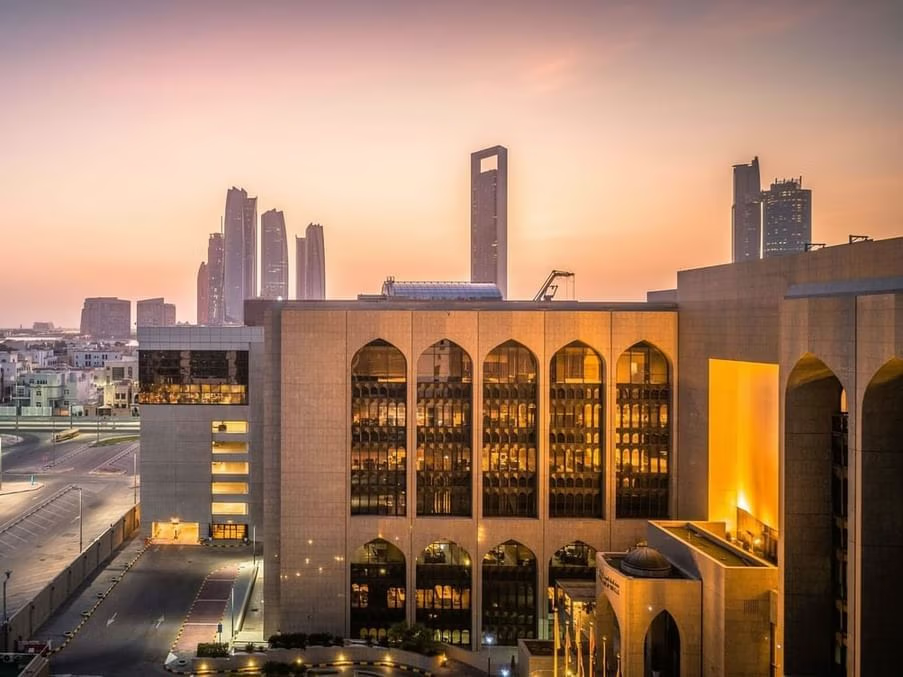
At the core of this momentum lies a robust financial system. Data from the Central Bank of the UAE shows that total banking assets crossed AED5.47 trillion in February, marking steady growth from the previous month. Credit expansion has remained healthy, supported by rising domestic lending, while deposits have also climbed, indicating strong liquidity within the system.
What stands out is the quality of this growth. Capital adequacy and liquidity metrics remain comfortably above global benchmarks, reinforcing confidence in the UAE’s banking sector at a time when financial stability remains a concern in many parts of the world.
This financial strength is being complemented by a sharp expansion in trade. The UAE’s push to deepen its global economic linkages through Comprehensive Economic Partnership Agreements is beginning to deliver tangible results. New agreements signed in the first quarter with countries such as the Philippines and Nigeria are part of a broader strategy to scale non-oil trade to AED4 trillion by 2031.
The impact is already visible. Total foreign trade reached AED6 trillion last year, while non-oil trade surged 27 percent, underscoring the success of diversification efforts. Recognition from the World Trade Organization, which placed the UAE among the world’s top 10 merchandise exporters for the first time, further validates this trajectory.
Investor confidence remains equally strong. Sovereign credit ratings have been reaffirmed by Moody’s and S&P Global Ratings, both citing the UAE’s fiscal resilience and strong asset base. With government net assets estimated at well above GDP, the country continues to enjoy significant financial buffers.
State-backed entities are also playing a crucial role in strengthening the economy. Mubadala Investment Company has expanded its asset base to AED1.4 trillion, delivering consistent long-term returns, while Abu Dhabi National Oil Company continues to enhance its global brand value, reflecting the strength of the UAE’s energy sector even as the economy diversifies.
Dubai, meanwhile, is strengthening its position as a global financial hub. Its rise to seventh place in the Global Financial Centers Index signals growing international confidence in its financial ecosystem, supported by regulatory clarity, capital market depth, and increasing global participation.
On the ground, business activity remains vibrant. The number of registered companies has crossed 1.45 million, with steady growth in new licenses and renewals across emirates such as Dubai, Sharjah, and Ajman. This reflects a healthy pipeline of entrepreneurial activity and sustained private sector confidence.
Even in debt markets, investor appetite remains strong. Recent treasury bond auctions have seen demand far exceed issuance, highlighting the attractiveness of UAE sovereign instruments in a volatile global environment.
Taken together, these trends paint a picture of an economy that is not only growing, but doing so with balance and resilience. The UAE’s ability to combine financial stability, trade expansion, and institutional strength continues to differentiate it in an increasingly uncertain global landscape.
As 2026 progresses, the focus will remain on sustaining this momentum while navigating external risks. For now, the data suggests that the UAE is firmly on track, reinforcing its status as a key economic hub bridging regional and global markets.
–Input WAM