

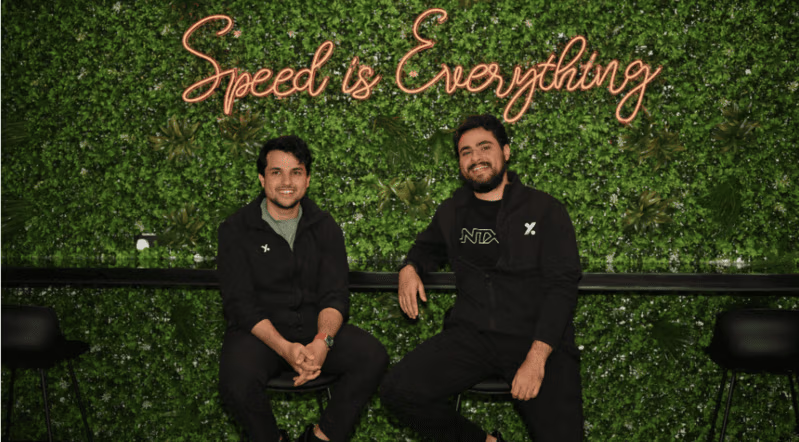
Abu Dhabi-based CNTXT AI has launched a new text-to-speech model designed specifically for Emirati Arabic, as regional demand grows for more localized and culturally relevant artificial intelligence solutions.
The model, named Munsit Emirati TTS, aims to deliver real-time, human-like voice responses that reflect how Emirati Arabic is naturally spoken, addressing a long-standing gap in voice technology where global systems have struggled to capture regional dialects accurately.
The launch comes at a time when voice-based interfaces are becoming increasingly central to digital services, from banking and telecom to government platforms and customer support systems. While recent advancements by global technology players have improved speech generation, many systems still rely on standardized or non-native accents that limit user engagement in local markets.
Munsit is designed to bridge that gap by enabling systems to respond instantly in spoken Emirati Arabic with natural tone, rhythm, and context. This allows organizations to integrate voice capabilities into customer interactions, automating responses while maintaining a more conversational and culturally aligned experience.
In practical applications, the technology enables banks to handle customer queries through automated voice systems, government entities to engage with citizens at scale, and contact centers to manage higher volumes of interactions without increasing operational costs.
According to the company, the model has demonstrated strong performance in testing, with 93 percent of Emirati and Arabic-speaking participants preferring it over leading global alternatives for naturalness, emotional expression, and dialect accuracy.
The operational impact is also notable. Organizations deploying AI-driven voice systems have reported cost reductions of 20-40 percent, alongside improvements in response times and overall service efficiency, particularly in high-volume environments such as call centers.
“Voice is no longer just an interface; it is becoming part of how services express identity,” said Mohammad Abu Sheik, Founder and CEO of CNTXT AI. “For a long time, the region relied on systems that did not fully reflect how people communicate. This changes that. We are building technology that speaks the language the way it is actually used, and that has a direct impact on trust, engagement, and how services are experienced.”
Shameed Sait, AI Director at CNTXT AI, said, “What we have built goes beyond generating speech. It reflects how people actually speak, the rhythm, the tone, and the cultural context behind it. The real breakthrough is making that work reliably in real-world environments and at scale.”
The development reflects a broader shift across the UAE and the wider Middle East, where organizations are increasingly moving away from generic or English-first AI systems towards solutions that better reflect local language and identity.
As voice becomes a key interface across digital ecosystems, the ability to deliver accurate, culturally relevant speech is emerging as a critical differentiator. With Munsit Emirati TTS, CNTXT AI is positioning itself at the forefront of this transition, offering a solution tailored to the region’s linguistic and operational needs.