

The UAE Fuel Price Committee has announced fuel prices for May 2026, with diesel rates held steady to support key sectors such as logistics and supply chains while ensuring broader market stability.
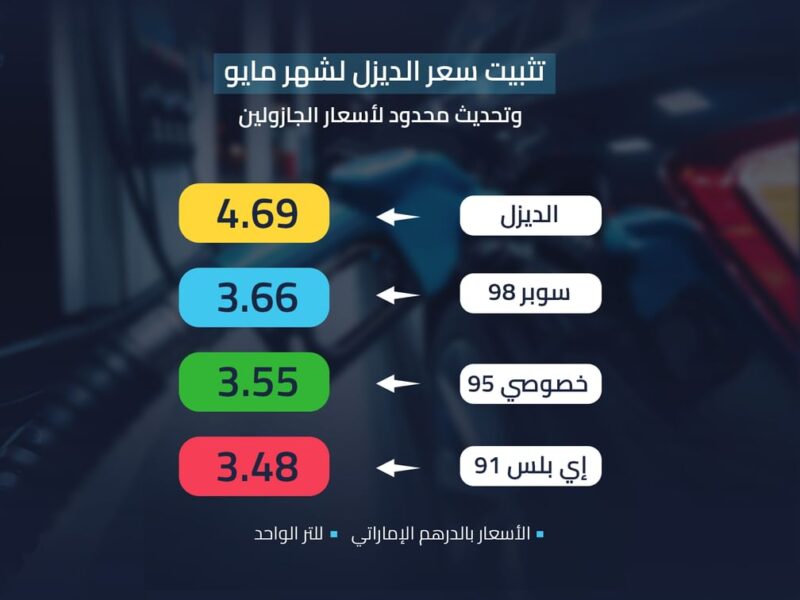
Diesel prices remain unchanged at AED4.69 per liter, signaling a policy focus on maintaining operational continuity for industries heavily reliant on fuel, including transportation, trade, and distribution.
Petrol prices, meanwhile, saw marginal adjustments in line with global market movements under the UAE’s monthly pricing mechanism, which is designed to reflect international energy trends while maintaining a balanced and transparent system.
The revised petrol prices for May are as follows:
- Super 98 at AED3.66 per liter
- Special 95 at AED3.55 per liter
- E-Plus 91 at AED3.48 per liter.
The decision to hold diesel prices steady comes amid ongoing global energy market volatility, driven by geopolitical developments and supply dynamics. By stabilizing diesel costs, the UAE aims to ease pressure on businesses and ensure the smooth functioning of supply chains.
The pricing framework, introduced as part of the UAE’s fuel deregulation policy, allows monthly adjustments based on global benchmarks, ensuring that domestic prices remain aligned with international trends while supporting economic sustainability.
Maintaining diesel prices is particularly significant for sectors that form the backbone of the UAE’s trade and logistics ecosystem. Stable fuel costs help manage operating expenses for transport operators and logistics companies, contributing to more predictable pricing across goods and services.
The move also reinforces the UAE’s broader strategy of balancing market responsiveness with economic stability, ensuring that fluctuations in global oil prices do not disproportionately impact critical sectors.
As the country continues to position itself as a global hub for trade and logistics, fuel price stability remains a key lever in supporting business confidence and operational efficiency across industries.