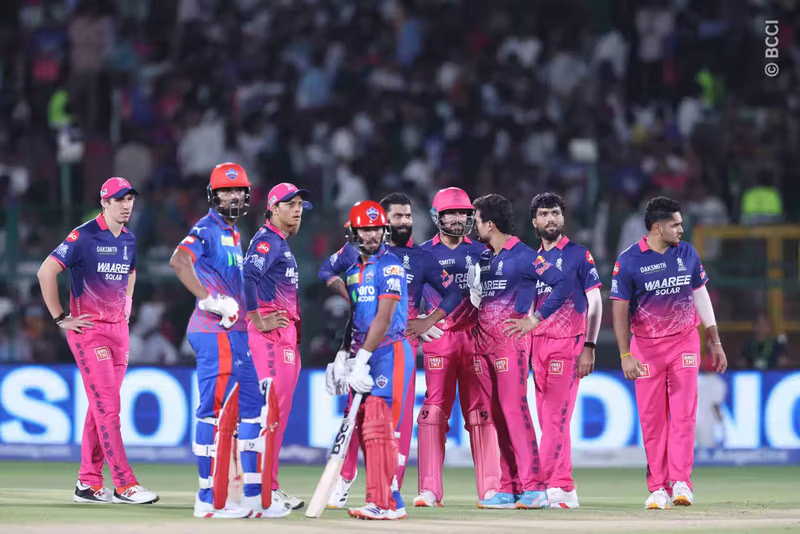
The Rajasthan Royals sale marks a defining moment in the business of cricket, underlining how far the Indian Premier League has evolved from a domestic tournament into a global sports economy. A consortium led by Lakshmi N. Mittal and Adar Poonawalla has agreed to acquire the franchise in a deal reportedly valued at around $1.65 billion, placing it among the most expensive transactions in cricket history.
What makes the Rajasthan Royals sale particularly significant is not just the valuation, but the profile of investors entering the space. Mittal, one of the world’s most prominent industrialists, and Poonawalla, a leading figure in India’s healthcare and biotech sector, bring with them deep capital reserves and a global outlook. Their entry reflects a growing recognition that IPL franchises are no longer just cricket teams but scalable sports businesses with multi-market potential.
The deal is understood to include not only the IPL team but also the broader Royals ecosystem, spanning franchise operations in South Africa and the Caribbean. This multi-league ownership model has become increasingly central to cricket’s commercial expansion, allowing stakeholders to build a year-round presence across geographies. For the incoming owners, this offers both diversification and a platform to develop a unified global brand.
Existing stakeholder Manoj Badale is expected to retain a minority interest and continue in an advisory capacity. His continued involvement provides continuity, especially given his long-standing role in shaping the Royals’ identity as a data-driven and innovation-led franchise. The blend of legacy expertise and new capital could prove critical as the team enters its next phase.
From a financial perspective, the Rajasthan Royals sale reinforces the sharp upward trajectory of IPL valuations. Over the past decade, media rights deals, sponsorship revenues, and digital engagement have transformed the league’s economics. The IPL today competes with the biggest global sports properties not just in viewership but in enterprise value. Deals of this scale indicate that investors see long-term upside, particularly as cricket expands into newer markets and formats.
The transaction, however, is yet to be formally closed and will require approvals from the Board of Control for Cricket in India and the IPL Governing Council. Such regulatory clearances are standard in franchise ownership changes, especially given the league’s tightly structured governance framework.
Beyond the numbers, the Rajasthan Royals sale also points to a broader shift in how sports assets are perceived. For ultra-high-net-worth individuals and global business leaders, teams are increasingly viewed as strategic investments that combine brand equity, media rights, and fan engagement into a single, high-growth asset class. The IPL, with its compressed format and massive audience base, sits at the center of this transformation.
Looking ahead, the new ownership could focus on expanding commercial opportunities, strengthening talent pipelines, and leveraging technology to enhance performance and fan experience. There is also likely to be an emphasis on deepening the Royals’ international footprint, particularly through their presence in multiple T20 leagues.
As the deal moves towards completion, it may well serve as a benchmark for future transactions in cricket and other emerging sports markets. The Rajasthan Royals sale is not just a change in ownership; it is a signal that the business of cricket has entered a new, more expansive phase, in which valuations, ambition, and global strategy are aligned on an unprecedented scale.