
The Central Bank of the United Arab Emirates said its proactive financial support package, aimed at strengthening the resilience of banks, businesses, and individuals, has reached AED6.2 billion in total facilities, underscoring its continued efforts to support economic stability amid ongoing market disruptions.
According to the central bank, the package included loan deferments, interest relief measures, and fee waivers provided across individuals, SMEs, and corporate entities.
The number of beneficiaries reached 65,379, including 60,559 individuals, 4,335 small and medium-sized enterprises, and 485 corporates.
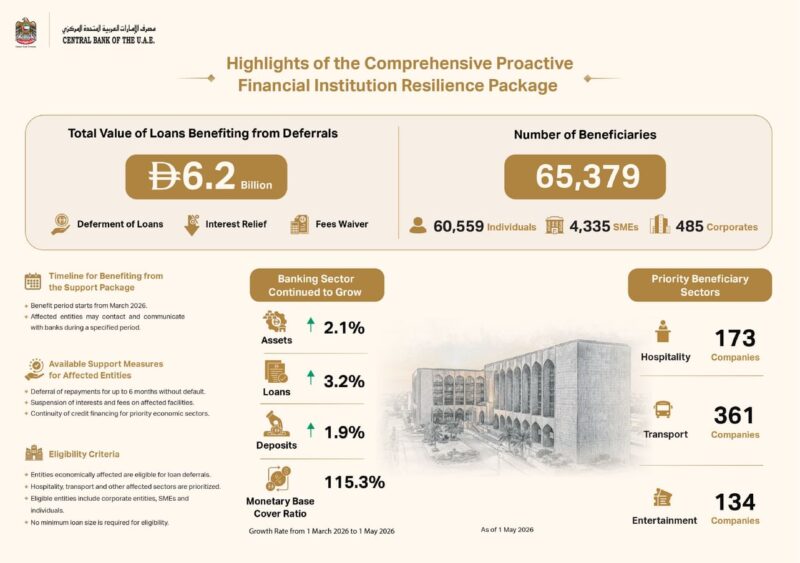
The hospitality, transport, and entertainment industries were among the priority sectors receiving support, with 173 hospitality companies, 361 transport firms, and 134 entertainment businesses benefiting from the programme.
The support measures form part of the UAE’s broader financial stability strategy, designed to help businesses and consumers navigate economic disruptions while maintaining the banking sector’s resilience and liquidity.
The CBUAE said the banking sector continued recording growth between March 1 and May 1, 2026, despite broader economic uncertainty.
During the period, banking sector assets increased by 2.1 percent, loans expanded 3.2 percent, and deposits rose 1.9 percent.
The monetary base cover ratio also reached 115.3 percent, reflecting what the central bank described as strong liquidity and financial stability conditions within the banking system.
Under the programme, affected businesses and individuals remain eligible to request deferment of repayment installments for up to six months without facilities being classified as defaults.
The package additionally includes suspension of interest charges and fees on affected facilities, while banks are encouraged to continue extending financing support to priority sectors.
The central bank said eligibility criteria apply to entities impacted by economic disruptions, with implementation prioritizing sectors most exposed to operational pressures and reduced activity.
Importantly, the CBUAE clarified that there is no minimum loan size requirement to qualify for assistance, broadening access to support across businesses and consumers.
The measures highlight the increasingly proactive role played by Gulf central banks in maintaining economic stability through targeted liquidity support and sector-focused relief mechanisms.
Industry analysts say the UAE banking sector has remained relatively resilient compared with several global markets due to strong capitalization levels, regulatory oversight, and continued government-backed support initiatives.
The latest figures also reinforce the UAE’s broader strategy of balancing monetary stability with continued support for growth-sensitive sectors, including tourism, transportation, and consumer-facing industries.
As global markets continue navigating geopolitical uncertainty, energy price volatility, and tighter financial conditions, central bank support programmes remain closely watched indicators of broader economic resilience.
With inputs from WAM