

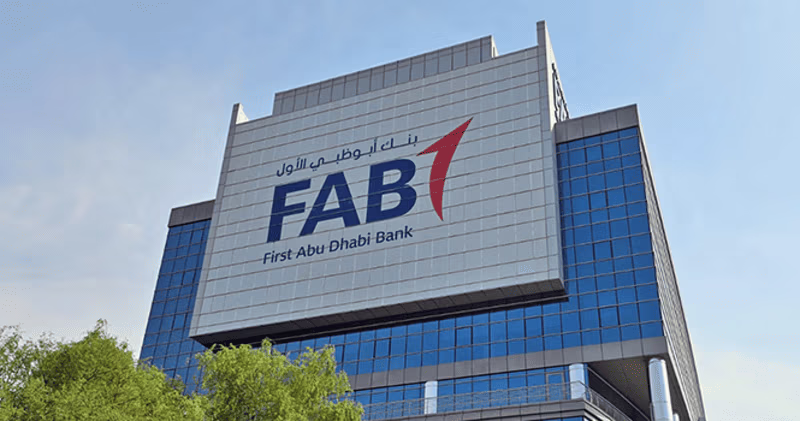
First Abu Dhabi Bank raised $700 million through a five-year sukuk issuance that attracted more than $1.5 billion in investor orders, highlighting continued appetite for high-quality Gulf debt despite elevated geopolitical and market uncertainty.
The Islamic bond issuance was significantly oversubscribed, with the order book reportedly exceeding $1.5 billion, according to market reports.
The transaction marks one of the first major international sukuk issuances from the region following heightened volatility linked to tensions in the Middle East and disruptions across global energy markets.
Despite strong investor demand, analysts noted that the pricing premium on Gulf debt has remained elevated relative to earlier issuance periods, reflecting broader caution in global fixed-income markets.
GlobalCapital noted that while FAB’s sukuk pricing tightened relative to secondary market levels, spreads remained significantly wider than those on the bank’s previous issuance.
FAB’s last sukuk issuance took place in January 2025, when the bank raised $600 million through a five-year issuance priced at 5.153 percent.
The latest deal nevertheless signals continued resilience across Gulf capital markets, where sovereign wealth strength, energy revenues, and strong banking sector fundamentals continue supporting investor appetite for regional debt instruments.
The sukuk market has remained particularly active across the Gulf as governments, banks, and corporates increasingly diversify their funding sources, benefiting from strong liquidity conditions in Islamic finance markets.
Industry analysts say Gulf issuers continue to attract global investors due to relatively strong balance sheets, stable banking systems, and lower default risks compared with several emerging-market peers.
At the same time, global debt markets remain highly sensitive to evolving interest rate expectations, geopolitical developments, and oil price volatility.
The pricing dynamics surrounding FAB’s issuance also reflect broader market caution as investors demand higher compensation for uncertainty tied to inflation, monetary policy, and regional geopolitical risks.
Still, the strong oversubscription demonstrates that institutional appetite for high-quality Gulf issuers remains intact.
The transaction also highlights Abu Dhabi’s growing role in international debt markets as regional financial institutions continue to expand funding activity across conventional and Islamic finance structures.
Islamic bonds, or sukuk, have become an increasingly important funding tool globally, particularly across the Gulf and Southeast Asia, where issuers continue tapping strong demand from both regional and international investors seeking Sharia-compliant fixed-income exposure.
The latest issuance comes amid continued growth across the UAE banking sector, supported by strong liquidity, rising deposits, and resilient economic activity tied to the country’s expanding non-oil economy.