

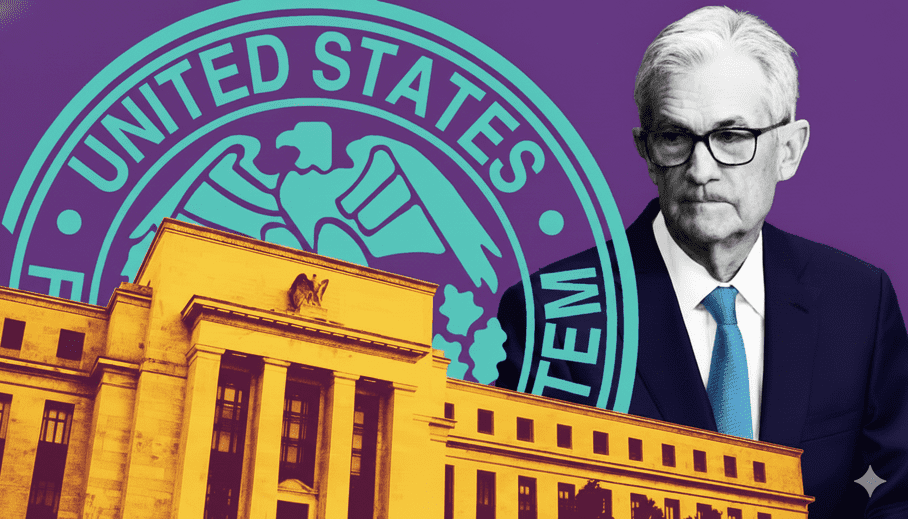
For much of the past year, the US Federal Reserve has been navigating territory it has not seriously confronted since the 1970s: a direct clash between its two core mandates, maximum employment and price stability.
Inflation has remained stubbornly above target, even as signs of a cooling labour market have grown harder to ignore. That tension has not only complicated policymaking but has also exposed deep divisions inside the central bank, with officials openly disagreeing on whether the greater risk lies in acting too late, or too soon.
Those divisions have been sharpened by a volatile political backdrop, as President Donald Trump’s economic agenda and public pressure on the Fed tested long-standing norms around central bank independence.
Trump’s Expanding Shadow Over Monetary Policy
As 2025 began, the Fed found itself in a wait-and-see mode. President Trump’s rapid-fire policy changes, ranging from aggressive new tariffs to tighter immigration controls, made it difficult for officials to assess how inflation, employment, and growth would ultimately be affected.
That pause infuriated the White House.
Trump repeatedly called for lower interest rates and escalated personal attacks on Fed Chair Jerome Powell, even exploring technical grounds to remove him. Those threats unsettled markets and raised fears of political interference in monetary policy, a red line for investors who rely on the Fed’s independence as a stabilising force.
While Powell ultimately remained in place, the president did remove Fed Governor Lisa Cook over alleged mortgage fraud, an issue still under litigation and scheduled for Supreme Court review early next year.
The turbulence didn’t end there. When Fed Governor Adriana Kugler stepped down during the summer, Trump appointed Stephen Miran, chair of the White House Council of Economic Advisers, to complete the remaining five months of her term. Miran took only a leave of absence from the White House, a move that alarmed Fed observers, including Miran himself, who had previously warned that such overlap could undermine institutional independence.
Tariffs, Inflation Fears, and a Cooling Jobs Market
Early in the year, many Fed officials believed tariffs would trigger only a temporary bump in prices. That view began to shift after April 2, dubbed “Liberation Day” by the White House, when Trump imposed the most sweeping and punitive tariffs in more than a century.
According to the Fed’s own communications, concern grew that tariffs could feed into longer-lasting inflation rather than fade quickly.
Throughout the summer, policymakers chose to observe rather than act. By July, the labour market was clearly losing momentum. Yet when the Fed again held rates steady, internal disagreements surfaced. Governors Chris Waller and Michelle Bowman dissented, arguing for a pre-emptive rate cut to cushion the slowing jobs market.
It was the clearest signal yet of a fractured central bank, split between those worried about inflation’s persistence and those alarmed by emerging labour market weakness.
By August, deteriorating employment data prompted Powell to signal that rate cuts were coming. The Fed delivered its first cut in September, followed by two more through the fall, mirroring the easing cycle seen in 2024.
Governing in the Dark During a Historic Shutdown
The policy environment became even more complicated in the fall, when the U.S. entered the longest government shutdown in history.
Without official federal data, the Fed was forced to rely heavily on private-sector indicators. While employment data remained relatively available, inflation metrics were far thinner, leaving policymakers to make critical rate decisions with incomplete information.
By December, divisions inside the Fed were unmistakable. The central bank cut rates for the third time, but not without dissent. Chicago Fed President Austan Goolsbee and Kansas City Fed President Jeff Schmid voted against the move, citing inflation concerns. On the opposite end, Stephen Miran dissented in favour of a much larger 50-basis-point cut. Six additional non-voting officials also signalled they would have preferred holding rates steady.
Inflation: Less Severe, But Still Unsettled
Despite earlier fears, tariff-driven inflation has so far been milder than many anticipated. Powell and Waller have both suggested price pressures linked to tariffs could peak in the first quarter of 2026 before easing.
Others are less convinced. Cleveland Fed President Beth Hammack and Dallas Fed President Lorie Logan, both voting members next year, have warned inflation may remain sticky and elevated for longer than markets expect.
That debate is now shaping the Fed’s cautious posture heading into 2026.
A Careful Reset for 2026
With three so-called “insurance cuts” already delivered and inflation still above the Fed’s 2 percent target, policymakers have signalled a pause to reassess conditions before making further moves.
Data delays from the government shutdown continue to muddy the outlook. Although November’s inflation report showed easing price pressures, particularly as rents declined, officials remain sceptical. New York Fed President John Williams has said the Consumer Price Index may be understating inflation by about one-tenth of a percentage point. Hammack believes the gap could be as large as two to three tenths.
Meanwhile, the unemployment rate has climbed to 4.6 percent – higher, but not yet alarming in the Fed’s view.
Looking ahead, most officials expect just one additional rate cut in 2026. While the labour market is softening, they do not see an emergency. At the same time, inflation remains uncomfortably high, and growth is expected to rebound with fiscal stimulus from the tax bill and the eventual recovery from the shutdown.
A New Chair, Same Old Dilemma
Next year will also mark the first change in Fed leadership in eight years. President Trump is widely expected to nominate a chair who favours lower interest rates.
Even so, consensus will not come easily.
Hammack, a voting member in 2026, has already said she prefers holding rates steady into the spring. If inflation remains elevated, even a dovish chair may struggle to push through aggressive easing.
For markets, the message is clear: the era of easy consensus at the Fed is over, and 2026 may test the institution’s independence, credibility, and judgment more than any year in recent memory.