

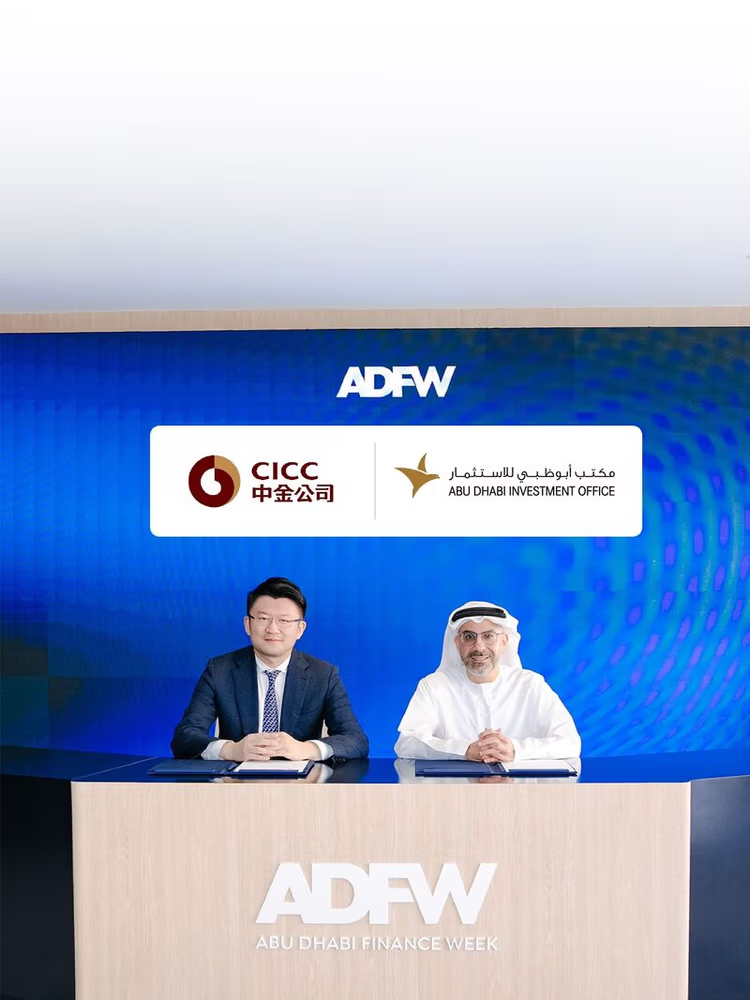
The Abu Dhabi Investment Office (ADIO) has formed a strategic partnership with China International Capital Corporation (CICC), one of Asia’s premier investment banks, to create an investment corridor that will accelerate two-way capital flows between Abu Dhabi and China.
The collaboration aligns with the launch of Abu Dhabi’s new FinTech, Insurance, Digital and Alternative Assets (FIDA) cluster, a major initiative aimed at expanding the emirate’s financial sector into high-growth segments.
Under the partnership, ADIO and CICC will identify rapidly expanding Chinese firms looking to benefit from Abu Dhabi’s strategic location, forward-looking regulatory environment and advanced infrastructure. They will also design tailored investment structures enabling Abu Dhabi-based institutional investors to gain direct access to China’s capital markets.
This investment corridor will support the FIDA cluster’s goals of directing capital into priority sectors, widening access to diversified financial instruments, and reinforcing Abu Dhabi’s role as a trusted global connector between East and West.
From its regional hub in Abu Dhabi, CICC plans to make use of the emirate’s evolving capital market landscape and progressive regulations. The bank intends to strengthen deal flow, introduce structured products, and provide bespoke discretionary portfolio management and family-office services for HNWIs and UHNWIs in the region, aligning with FIDA’s emphasis on advanced wealth management, alternative assets and next-generation financial innovation.
By combining CICC’s global capabilities with ADIO’s full suite of services, the partnership will unlock new avenues for capital deployment, drive economic diversification, and foster mutual prosperity. It also underscores how global institutions can utilise the FIDA cluster to design, structure and scale cutting-edge financial products from Abu Dhabi.
The cooperation additionally encompasses market-entry advisory, ESG-linked financing solutions and co-branded thought-leadership programmes that support sustainable growth. A dedicated workstream will focus on expanding ESG investment vehicles, such as green bonds, transition-linked loans and sustainable private equity, aligned with both countries’ net-zero objectives and bolstering FIDA’s role in advancing transition and sustainable finance across Abu Dhabi’s financial sector.
ADIO and CICC will further collaborate with local universities, research entities and startups to incubate new financial products and services while cultivating talent in the financial industry.
Badr Al Olama, Director-General of the Abu Dhabi Investment Office, said, “Abu Dhabi is building a future-focused financial ecosystem that connects innovation with capital. Announcing this partnership alongside the launch of our new FIDA cluster demonstrates how we are aligning strategic capital, breakthrough innovation and progressive regulation to position Abu Dhabi as a pioneering global hub for next-generation financial solutions. Partnering with CICC demonstrates Abu Dhabi’s leading position as a trusted global gateway between East and West.”
Wilson Zhang, Managing Director, Global Executive Head of Equities, at China International Capital Corporation, added, “Establishing a regional hub in Abu Dhabi aligns perfectly with our strategy to deliver sophisticated financial solutions to clients worldwide. By anchoring our regional growth within Abu Dhabi’s expanding financial ecosystem, including the newly launched FIDA cluster, we will introduce new investment products, champion sustainable finance, and generate long-term value for businesses, investors, and communities across both economies.”
Founded in 1995 as China’s first joint-venture investment bank, CICC has grown into a comprehensive financial institution with operations spanning investment banking, asset management, wealth management and private equity. This strategic partnership positions Abu Dhabi as the centrepiece of CICC’s expansion in the Middle East, establishing the emirate as its regional headquarters and a springboard for future investment-banking mandates.
(Inputs from WAM)