
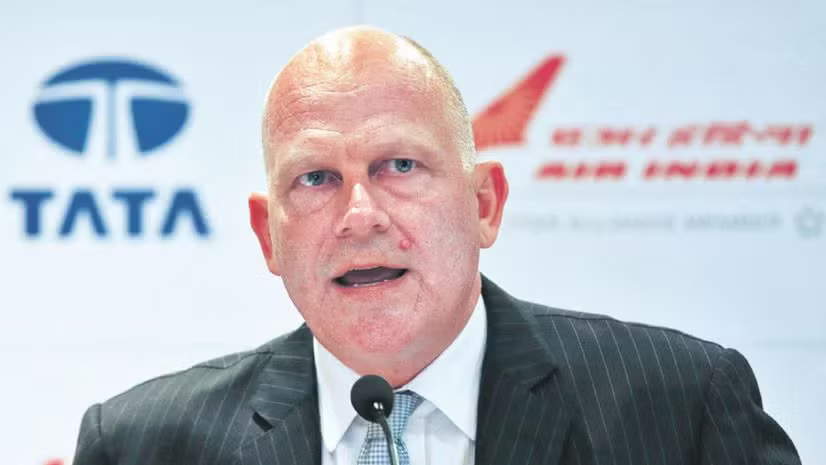
Air India Campbell Wilson’s resignation marks a turning point in the Tata Group’s effort to rebuild the carrier, with the outgoing chief executive saying the airline is entering a new phase that requires fresh leadership.
Wilson, who has led Air India since its privatization in 2022, told employees it was the “right time” to hand over the reins as the airline prepares for the next stage of its growth cycle.
His departure comes after nearly four years at the helm, during which the airline undertook one of the most ambitious transformations in Indian aviation, moving from a state-run entity to a privately managed carrier under the Tata Group.
Wilson indicated he would remain in the role until a successor is appointed, ensuring continuity as the airline transitions leadership.
The timing of the exit reflects both progress made and challenges ahead. In his message to staff, Wilson pointed to a window before large-scale aircraft deliveries begin from 2027, linked to Air India’s order book of nearly 600 aircraft. That inflection point, he suggested, makes it an appropriate moment for leadership change.
Since the Tata takeover, Air India has undergone a broad overhaul that extended beyond fleet expansion. The airline integrated multiple carriers, revamped leadership structures, and shifted operating practices toward private-sector standards. It also added more than 100 aircraft and began modernizing cabins and service offerings as part of a long-term repositioning strategy.
Yet the transformation has been uneven. The airline has faced persistent headwinds, including supply chain disruptions, delays in aircraft deliveries, rising fuel costs, and geopolitical constraints, all of which have complicated flight operations. Wilson acknowledged these pressures, as well as what he described as more acute challenges, including a fatal crash in 2025 that intensified scrutiny of the airline’s operations.
The leadership change comes at a critical juncture. Air India is attempting to balance near-term operational stability with a longer-term ambition to position itself as a global network carrier. The next phase is expected to be defined by fleet induction, network expansion, and execution discipline, areas where investors and industry observers will be watching closely.
Wilson’s tenure leaves behind a mixed but consequential legacy. He oversaw the early stages of Air India’s restructuring, laying the groundwork for modernization, while navigating a complex operating environment that tested both strategy and execution.
For the Tata Group, the challenge now shifts from transformation to delivery. With capital commitments already in place and a large aircraft pipeline ahead, the focus will increasingly be on translating investment into performance.
The appointment of Wilson’s successor will therefore be closely watched, not only for its operational implications but also for what it signals about the group’s long-term vision for Air India’s place in the global aviation market.