

Google’s parent company, Alphabet, exceeded the expectations of Wall Street in its fourth quarter, but a new, high threshold on estimations of spending on artificial intelligence infrastructure dampened enthusiasm.
The Google parent company shares continued to fall in prolonged trading on Wednesday despite surpassing expectations in revenue, earnings per share, and cloud, indicating that Wall Street is still sensitive to AI expenditure.
Alphabet claimed that its capital expenditure is likely to be between $175 billion and $185 billion in 2026. Its highest point on that forecast would be over twice its 2025 capex spending.
The projection lets Alphabet set the yearly benchmarks of how it will expand in 2026 and try to boost its popularity on Wall Street. The company stated that it anticipated “a significant increase” in capex in 2026, but the estimates posted on Wednesday were higher than those of its hyperscaler competitors.
Microsoft, in its quarterly report last week, did not make a specific forecast for the year, but it said capex will “decrease on a sequential basis” this quarter, after the company reported capex of $37.5 billion in the most recent period.
Meta forecasted that it would spend between $115 billion and $135 billion in 2026; this is nearly twice the amount spent last year of $72.2 billion. Amazon reports results on Thursday.
According to FactSet, analysts anticipate that the capex of the company will come to an end in 2025 at approximately $124.5 billion and that it is going to grow 18 percent this year.
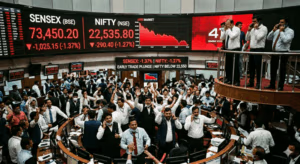
The increase in Alphabet’s spend is timed when Wall Street has been specifically sensitive to additional AI spend. CNBC’s Michael Santoli said that, the Regardless of this good tech performance, the entire software industry has fallen by 30 percent in the past three months.
However, that is due to concerns that AI tools will upend the current software tools and make higher spending riskier. Alphabet has been spared from any significant movements in its stocks, particularly since it was among the best-performing stocks of 2025.
Meanwhile, Wall Street fusses about the wasteful expenditure, the tech companies are scrambling to create additional infrastructure to accommodate customer requests for AI services.
Alphabet’s finance chief, Anat Ashkenazi, stated on a call on Wednesday that the backlog of Google Cloud, which shelters the majority of its AI products and services, grew by 55 percent sequentially and over 200 percent year-over-year to a total of more than $240 billion at the end of the fourth quarter.
Google has generated a close of 48 percent growth in cloud revenue as compared to last year. Ashkenazi added that the intended 2026 capex investment will be utilized in Google DeepMind AI compute capacity investment and to address the “significant cloud customer demand as well as strategic investments in other bets.”
She reported that it would also be used to “improve the user experience and drive higher advertiser ROI in Google services.” Ashkenazi disaggregated the way Alphabet used capex in 2025, which might reflect the way the company will invest this year.
Ashkenazi indicated, “The vast majority of our capex was invested in technical infrastructure with approximately 60% of that investment in servers and 40% in data centers and networking equipment in Q4.”
Between the explanation of the Capex upsurge, the executives in Wednesday call boasted of AI victories of the quarter. Executives noted that Google’s flagship AI application Gemini has 750 million monthly active users, compared to 650 million last quarter.
Alphabet CEO Sundar Pichai tilted towards the company’s deal with Apple to redesign the Siri virtual assistant with the Gemini AI models and restated that the iPhone-maker has selected Google as its preferred cloud of choice.
When asked what keeps executives up at night, Pichai responded, “compute capacity.” He added, “Be it power, land, supply chain constraints, how do you ramp up to meet this extraordinary demand for this moment?”
Alphabet decided to acquire data center company Intersect in December, which had 4.75 billion in cash and debt as a condition. The remarks of Pichai can be seen in the news of CNBC that indicated the firm is experiencing costly pressure to construct promptly.
CNBC reported in November that Amin Vahdat, Google’s AI infrastructure head, informed his employees that the company must increase its serving capacity by twofold every 6 months to satisfy AI services demand.
Vahdat said, “The competition in AI infrastructure is the most critical and also the most expensive part of the AI race.”