

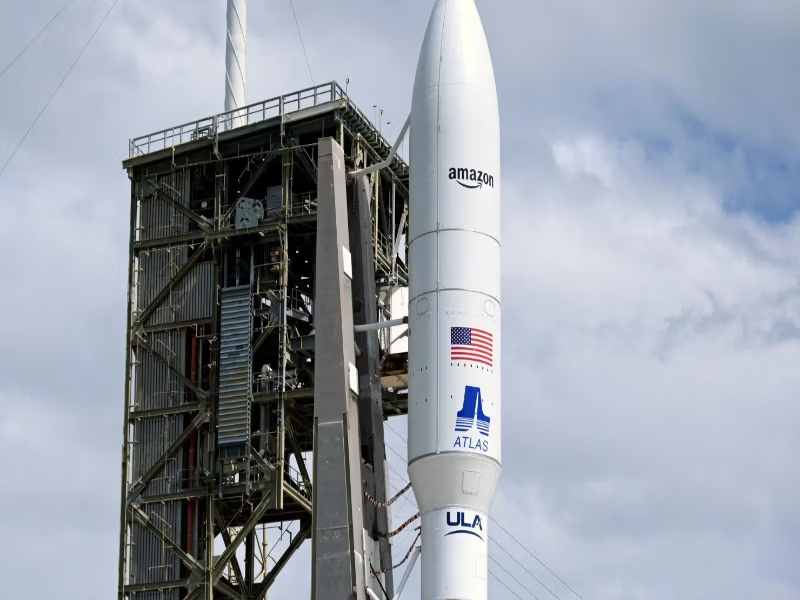
Amazon has requested that the Federal Communications Commission grant additional time to fulfill a deadline under which the company to deploy approximately 1,600 internet satellites by July 2026.
The company must make more of its satellites come online to be able to start providing an internet-from-space service, which got a new name, Amazon Leo. The company has already set aside at least $10 billion to develop the network.
The company said in a filing made public on Friday that the delays were beyond Amazon’s control, a “shortage in the near-term availability” of rockets, which required an extension. Amazon also cited manufacturing disruptions, failure and grounding of new launch vehicles, and limitations on spaceport capacity.
The company wrote, Leo is “producing satellites considerably faster than others can launch them.” The company is now requesting an extension, which can be by July 2028, or waiving its deadline by the FCC, as Amazon needs about half of its 3,236 on low Earth satellites
Amazon announced its intention to construct a network of low Earth orbit satellites in 2019. They are built in such a way that they deliver high-speed, low-latency internet services to consumers, corporations, and governments, and they are connected to them via square-shaped terminals.
Amazon has ordered more than 100 launches to place dozens of satellites simultaneously. In the filing, the company noted that it has purchased 10 additional launches with the space exploration venture of Elon Musk, in addition to 12 other rides with Blue Origin, the space exploration venture of the Amazon founder Jeff Bezos.
The company has reported that numerous of its partners have achieved considerable milestones in launching their respective rockets within the last year.
The company wrote, “Not withstanding this progress, the development timelines for these next-generation vehicles have extended beyond initial projections, contributing to Amazon Leo’s deployment delays.”
Meanwhile, Amazon has launched more than 150 satellites since April. The company has projected that it deploy approximately 700 satellites by July 30, “moving from the third- to the second-largest satellite constellation in orbit.”
Its second launch is planned on Feb. 12, where Amazon will launch another 32 satellites into space on top of a rocket by Arianespace, a French firm.
SpaceX is the main competitor of Leo since its satellite network, Starlink, has more than 9,000 satellites and approximately 9 million subscribers. OneWeb is another competitor, run by Eutelsat of France, and operates a constellation of more than 600 satellites.
Amazon rolled out an “enterprise preview” of Leo to a few users before a wider commercial release in November. Amazon mentioned that in case FCC would refuse it an extension, it would “undermine” the motives of the agency to increase spectrum access and encourage “expeditious deployment.” Therefore, the company also stated that the agency has already granted such extensions previously.
The company stated, “Amazon Leo is engaged in full-scale deployment and stands on the doorstep of offering U.S. customers a competitive and innovative new service. An extension would enable this rapid and ongoing deployment to continue, while strict enforcement would interrupt or halt this effort.”