
Asia-Pacific markets fell largely on Monday, with investors evaluating threats against Greenland by the Trump administration over the weekend, and critical economic data released by China on Monday.
During the weekend, U.S. President Donald Trump and European leaders engaged in combative rhetoric over the territory in the Arctic, with Trump threatening to levy tariffs on eight European nations and demanding control of Greenland, an autonomous part of Denmark.
European leaders reacted to the threats as “completely wrong” and “unacceptable.” China came up with its fourth-quarter GDP results, as well as December retail sales, urban investment, and industrial production in Asia.
Therefore, the Hong Kong Hang Seng index dropped 1.05 percent, and the mainland Chinese CSI 300 dropped slightly. Japanese Nikkei 225 fell by 0.97 percent, which was the largest in Asia, with the Topix slipping by 0.47 percent. The Japanese Government Bonds Yields increased to new records on long-term bonds.
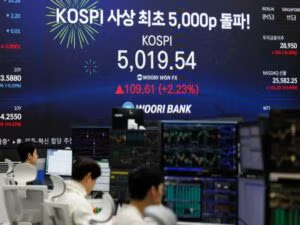
The benchmark 10-year JGB yield recorded a high of 2.244 percent, its highest level since 1999. Yields on 20- and 30-year JGBs also surged to record highs. The markets of South Korea defied the general trend with the Kospi advancing 0.81 percent, and the small-cap Kosdaq advancing 0.68 percent.
However, the Automaker Hyundai hit a record high as its shares shot up by up to 12.59 percent on Monday. Australia’s S&P/ASX 200 plummeted 0.48 percent, dragged by tech stocks.
On the commodity front, both spot silver and gold prices reached record highs. Silver was up over 3.63 percent to $93.17 per ounce, and gold last traded 1.58 percent higher at $4,668.19 per ounce.
The S&P 500 closed barely above the flatline on Friday in the U.S and recorded a negative week, with the Nasdaq Composite declining by 0.06 percent. The Dow Jones Industrial Average dropped by 0.17 percent.
The three big indexes reached their lowest point in the session when Trump indicated in the White House on Friday that he would prefer that National Economic Council Director Kevin Hassett remain in his present position and that he may not be selected to be the next U.S. Fed chair.
Hassett has been viewed as a more market-friendly choice over the current Fed chair than the new nominee, former Fed Governor Kevin Warsh, and is likely to be more open to holding rates down.