

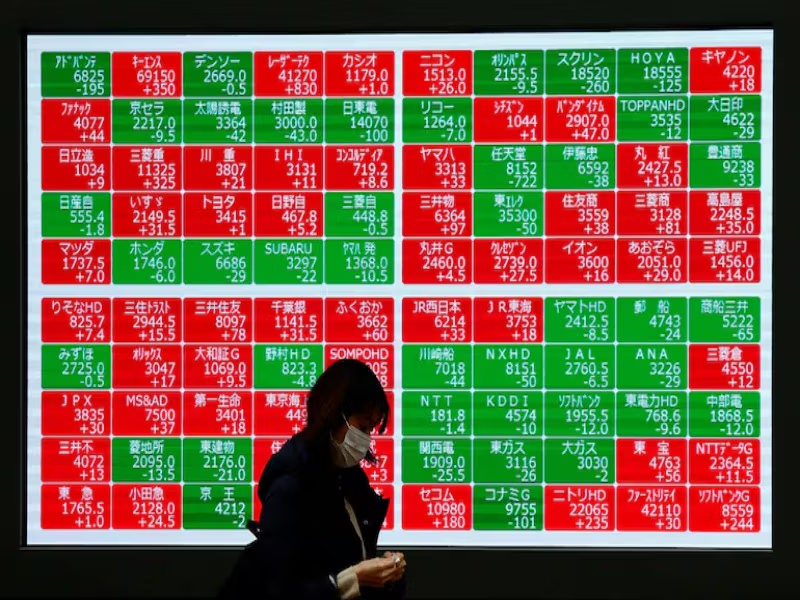
Asia-Pacific markets were trading both ways on Monday as investors evaluated the current geopolitical issues. Canadian Prime Minister Mark Carney said on Sunday stateside that his country has no plans to pursue a free trade agreement with China, after U.S. President Donald Trump threatened to impose 100 percent tariffs on Ottawa if it signed a trade deal with China.
Carney stated, “Canada respects our engagements, our commitments. We have commitments under CUSMA (Canada-United States-Mexico Agreement) that not to pursue free trade agreements with non-market economies without prior notification. We have no intention of doing that with China or with other non-market economy.”
The Nikkei 225 of Japan dropped by 1.52 percent, and the Topix went down by 1.76 percent. South Korea’s Kospi gained 0.64 percent while the small-cap Kosdaq surged 2.28 percent. The Japanese yen has previously appreciated by 0.45 percent to trade at approximately 155.01 percent against the dollar.
Japanese stocks and the yen will remain under intense investor scrutiny following a sudden surge in the yen on Friday, after the Japanese prime minister commented to offset speculative market action and warned that authorities stand ready to act if volatility intensifies.
Barclays’ economists wrote in a note on Sunday, “The yen rallied on rising risk of intervention, with spillovers to the broad USD. While a cautiously hawkish stance from the FOMC along with resilient data should offer some support, a potential yen intervention can aggravate a weak flow picture for the dollar.”
Hong Kong Hang Seng index dropped 0.26 percent, while the mainland’s CSI 300 added 0.27 percent. Australia’s S&P/ASX 200 increased by 0.13 percent. Spot gold prices hit a record high of over $5,000 per ounce, with investors flocking to safe-haven assets amid geopolitical uncertainties, also aided by a weaker greenback. The U.S. dollar index slipped by 0.52 percent to 90.087.
Therefore, the Singapore dollar gained momentum to 1.271 per dollar, its highest in over a decade. The U.S. futures contracts were trading at a lower level on Monday, as the traders were anticipating a huge week with the major earnings announcements and an American monetary policy meeting.
Dow Jones Industrial Average futures lost 131 points, or 0.27 percent. S&P 500 and Nasdaq-100 futures declined 0.33 percent and 0.48 percent, respectively.
In the United States, the major benchmarks closed mixed last Friday, with the Nasdaq Composite adding to its gains as geopolitical fears were reduced, and the Dow Jones Industrial Average lagging.
The tech-heavy Nasdaq gained 0.28 percent and closed at 23,501.24, while the blue-chip Dow lost 285.30 points, or 0.58 percent, closing at 49,098.71. An almost 4 percent decline in Goldman Sachs dragged on the 30-stock index. The broad market S&P 500 slight marginal increase of 0.03 percent to end at 6,915.61.