

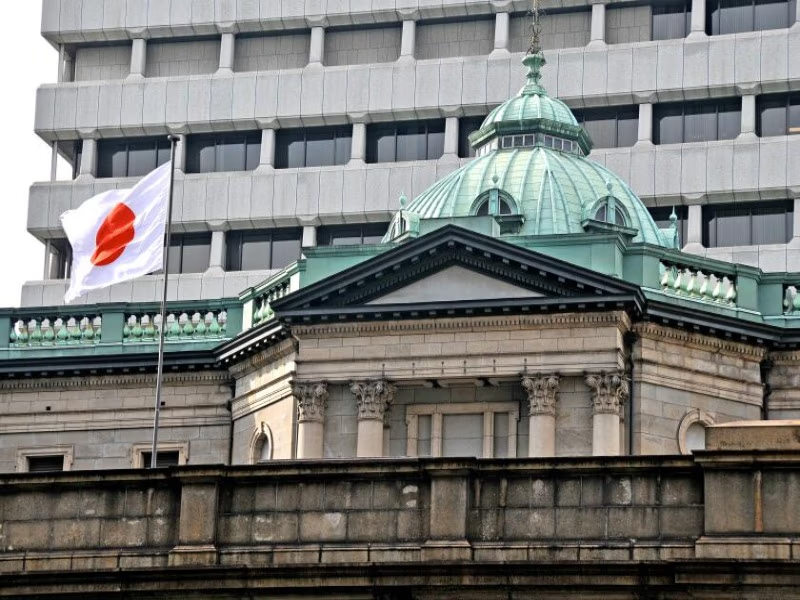
The central bank of Japan on Friday revised its economic growth expectations higher and maintained the key policy rate at 0.75 percent as the nation enters an election.
The Bank of Japan also increased its economic growth forecasts of the fiscal year that ends in March 2026 to 0.9 percent, as compared to 0.7 percent in October 2025, and also increased its GDP expansion forecasts of the 2026 fiscal year to 1 percent, compared to 0.7 percent.
The GDP of Japan is projected to increase moderately, as the other nations emerge with recovery, and the BOJ anticipates such a virtuous cycle of increasing prices and wages that will be backed by the economic policies and favorable financial environment in Japan.
The benchmark interest rate was maintained at its current level in an 8-1 vote, following a hike to the highest rate in 30 years in December, and preceding snap polls that may force Prime Minister Sanae Takaichi to become even more vociferous in advocating monetary easing and fiscal stimulus.
In its announcement, the BOJ disclosed that one of its board members, Hajime Takata, had suggested an increase in rates to 1 percent by arguing that the price risks in Japan were unbalanced towards the upward side.
The bank that predicts the inflation to drop to below the 2 percent target in the first half of the year anticipates the underlying inflation to continue rising moderately.”
Masahiko Loo, Senior Fixed Income Strategist at State Street Investment Management, the wage growth and the sticky prices of services that still operate above 2 percent.
He said, “This firm underlying inflation reinforces our view that the BOJ’s normalization path will stay intact, albeit at a gradual pace.”
The December inflation figures of Japan, which were announced earlier in the day, indicated that the headline price growth has been recorded at 2.1 percent, which is the lowest since March 2022, however, running above the target price of 2 percent marked by the BOJ over 45 consecutive months.
Therefore, the so-called “core-core” inflation, which strips out fresh food and energy prices, came in at 2.9 percent in December. Japan took the road to policy normalization in March 2024, giving up the last negative interest rate regime in the world, and emphasized increasing rates under the condition of a virtuous circle of growth in prices and wages.
This policy has fallen under political pressure with prominent names, including Takaichi, advocating for softer rates to fuel economic expansion. The economy of Japan contracted further than had been previously estimated in the third quarter, shrinking by 0.6 percent quarter to quarter, and also 2.3 percent on an annualized basis.
Although the monetary tightening by BOJ has increased, Japanese bond yields have been on the increase in the last month, hitting the multidecade highs and causing capital outflow and devaluing the yen.
According to the BOJ, as well as mounting fiscal worries, this is against a backdrop of real rates still being negative. Takaichi had hoped to have a record $783 billion budget in the next fiscal year, starting April 1, and on top of a $135 billion stimulus package last year to assist households due to the increased cost of living.
Strained by the escalating yields amid fiscal issues, the Yen has experienced a major depreciation against the dollar at the end of last year, depreciating by nearly 4.6 percent since the time Takaichi assumed power on October 21 as prime minister till the present level of 158.97.
This was the area of weakness that made Finance Minister Satsuki Katayama warn against “one-sided” actions in the currency. Katayama reportedly told reporters in Washington last week that she has expressed her deep concern about the weakening of the yen, and Treasury Secretary Scott Bessent agreed with her about the one-sided weakness in the Japanese currency.
She reported that the bond market rout had appeared to have receded on Friday, and that she was closely monitoring financial markets with a “high sense of urgency.”
Therefore, State Street’s Loo added that his base case for the BOJ is one hike in 2026 and another in 2027 with a terminal rate of 1.25 percent. In case the yen breaks the 160 points against the dollar, it may have two increases this year and one as early as April, with the terminal rate being 1.5 percent.
Thus, the terminal rate, also known as the neutral rate, balances inflation and economic expansion. Takaichi on Friday dissolved Japan’s Lower House, with the country set to go to the polls in a snap election on February 8.