
Canada and China are moving to repair a relationship that has been strained for years.
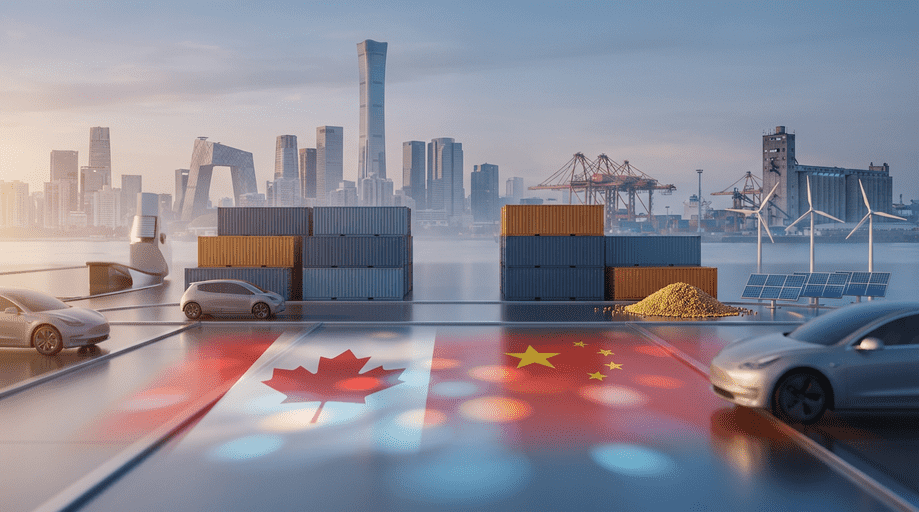
On Friday, Canadian Prime Minister Mark Carney announced that a preliminary trade deal had been reached with China, marking the most significant shift in bilateral ties since 2017. The agreement includes reduced tariffs on Chinese electric vehicles entering Canada and sharp tariff cuts on Canadian agricultural exports to China.
Carney said the deal signals a “new era” in relations between Ottawa and Beijing. The announcement came during Carney’s four-day visit to China, the first by a Canadian prime minister in eight years.
Why this visit matters
Relations between Canada and China collapsed under former Prime Minister Justin Trudeau. Ties hit their lowest point in 2018 after Canada arrested the daughter of Huawei founder Ren Zhengfei at the request of the United States. China responded by detaining two Canadians on espionage charges.
Trade frictions deepened in 2024 when Canada imposed a 100 percent tariff on Chinese electric vehicles and a 25 percent tariff on Chinese steel and aluminium. Beijing later retaliated with steep tariffs on Canadian farm products.
Carney’s visit comes as both Canada and China face growing tensions with the United States under President Donald Trump. Before travelling, Carney said his priority was building an economy less dependent on the U.S. during “a time of global trade disruption”.
Who Carney met in Beijing
Carney arrived in Beijing on Wednesday.
He met President Xi Jinping, Premier Li Qiang, and Zhao Leji, the head of China’s legislature. He brought diplomatic gifts, including a spalted birch wood sculpture from British Columbia and a carving of a crane made from muskox horn. The Prime Minister’s Office said the gifts symbolised renewal, peace, partnership, and resilience.
Carney and Xi had previously met in October at the Asia-Pacific Economic Cooperation summit in South Korea. At that meeting, Xi said he wanted to restart cooperation and “make up for lost time”.
On Friday, Carney praised what he called a “new strategic partnership” between the two countries.
“Together we can build on the best of what this relationship has been in the past to create a new one adapted to new global realities,” Carney said.
He added that engagement and cooperation would be “the foundation of our new strategic partnership”.
“Agriculture, energy, finance, that’s where we can make the most immediate progress,” Carney said.
Xi welcomed the shift. “It can be said that our meeting last year opened a new chapter in turning China-Canada relations toward improvement,” Xi said. “The healthy and stable development of China-Canada relations serves the common interests of our two countries.”
“I look forward to continuing to work with you, with a sense of responsibility toward history, our peoples, and the world, to improve China-Canada relations further,” Xi told Carney.
Carney also met Zhao Leji. “We’re heartened by the leadership of President Xi Jinping and the speed with which our relationship has progressed,” Carney said. “It sets the stage for these important discussions on a wide range of issues.”
In a separate meeting with Premier Li Qiang, Carney said teams from both sides had worked to resolve trade disputes.
“Our teams have worked hard, addressing trade irritants and creating platforms for new opportunities,” Carney said. “I believe that together, we are bringing this relationship back toward where it should be.”
Carney is scheduled to attend a gala dinner hosted by the Canada-China Business Council on Friday evening.
What Canada gained from the deal
The centrepiece of the agreement is trade. Canada will import 49,000 electric vehicles from China at a reduced tariff rate of 6.1 percent, effectively restoring most-favoured-nation treatment. Under the Trudeau government, Canada imposed a 100 percent tariff on Chinese EVs in 2024.
In 2023, China exported 41,678 EVs to Canada.
Trudeau had argued that Chinese automakers benefited from state subsidies and posed a threat to Canadian manufacturers. “This is a return to levels prior to recent trade frictions, but under an agreement that promises much more for Canadians,” Carney said in Beijing.
China is Canada’s second-largest trading partner after the United States. Total trade reached $84.9 billion in 2024. The U.S., however, still dominates Canadian exports, buying about 75 percent of all goods. China accounted for less than four percent.
Agriculture sees the biggest relief
China agreed to lower tariffs on Canadian canola seed by 1 March, bringing the combined rate to about 15 percent. It will also remove tariffs on canola meal, lobsters, crabs, and peas until the end of the year.
Canada is the world’s largest canola exporter.
“This change represents a significant drop from current combined tariff levels of 84 percent,” Carney said.
China is a $4 billion canola seed market for Canada. Carney said the deal would unlock nearly $3 billion in export orders for farmers, fish harvesters, and processors.
China had previously imposed a 100 percent tariff on canola oil and meal, a 25 percent levy on pork and seafood, and a 75.8 percent tariff on canola seed in August 2025. Industry groups said the measures effectively shut Canada out of the Chinese market. Imports of Canadian goods fell 10.4 percent as a result.
Beyond trade
Canada and China also signed multiple memorandums of understanding. These covered energy, crime, construction, culture, food safety, and plant and animal health.
One agreement aims to boost exports of Canadian oil and increase imports of Chinese green energy technology. In 2024, Canada sent only two percent of its oil exports to China.
Carney also met executives from Primavera Capital Group, CATL, China National Petroleum Corporation, Alibaba Group, and Envision Group.
Foreign Affairs Minister Anita Anand said Canada plans to reduce its reliance on the U.S.
“We will double non-U.S. trade over the next 10 years,” Anand said in Beijing. “The global economic environment has fundamentally changed and Canada must diversify its trading partners.”
She said Carney’s visit was about recalibrating the relationship with China. Early signs suggest that the process is already underway.