
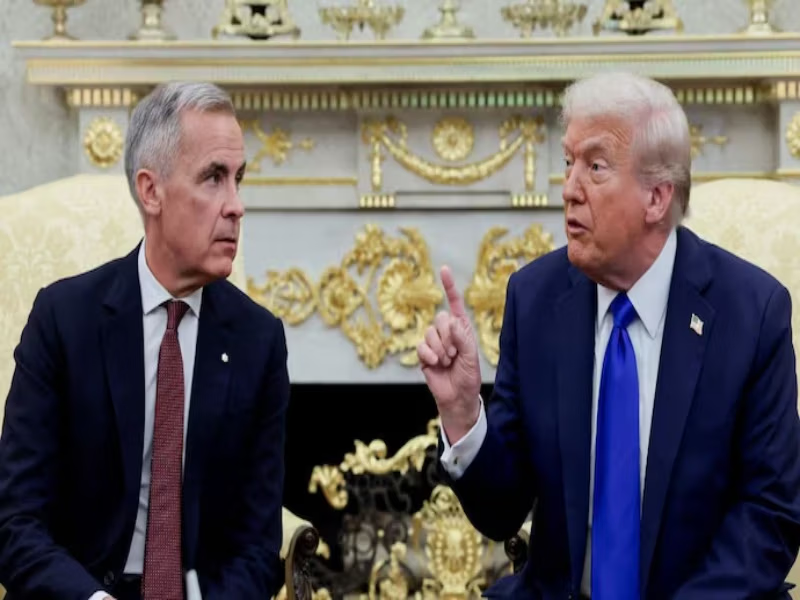
Canada has “no intention” of entering into a free trade agreement with China, Prime Minister Mark Carney replied, when U.S. President Donald Trump threatened to impose punitive tariffs on Ottawa.
In an interview with reporters on Sunday, Carney declared that the country honors its commitments under the Canada-U.S.-Mexico trade agreement, known as CUSMA in Canada and the USMCA in the U.S., and that it would not seek a free trade agreement before informing the other two countries.
Carney made the comments following threats of a 100 percent tariff on Canadian exports if Ottawa “makes a deal” with Beijing.
Trump posted on Truth Social Saturday, “If Governor Carney thinks he is going to make Canada a ‘Drop Off Port’ for China to send goods and products into the United States, he is sorely mistaken.”
The comments follow the escalating tensions between the U.S. and Canada, with Trump last week rescinding his invitation to Ottawa to join his “Board of Peace”, with Carney in his speech at the World Economic Forum in Davos warning about economic coercion by the world’s superpowers.
Although Carney did not name any country, Trump said on the sidelines of the WEF that “Canada lives because of the United States. Remember that, Mark, the next time you make your statements.”
Trump’s fiery rhetoric on Truth Social contrasts with what he said after the deal between Ottawa and Beijing earlier this month: “That’s what he [Carney] should be doing. It’s a good thing for him to sign a trade deal. If you can get a deal with China, you should do that.”
Treasury Secretary Scott Bessent also shared the views expressed by Trump towards Canada and China by telling ABC News on Sunday that the U.S could not “let Canada become an opening that the Chinese pour their cheap goods into the U.S.”
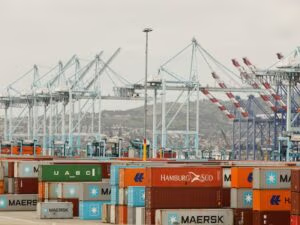
Ottawa and Beijing settled a “preliminary agreement,” with both sides lowering tariffs on select goods on January 16. Under the agreement, Canada will permit 49,000 Chinese electric vehicles into the market each year at a reduced tariff rate of 6.1 percent, after increasing tariffs on such vehicles to 100 percent in October 2024 with the U.S.
In its turn, Beijing is likely to cut duties on Canadian agricultural exports, such as canola seed oil, which will witness tariffs decline to 15 percent from March 1, down from the current 85 percent.
However, other exports, including Canadian canola meal, lobsters, crabs, and peas, will also not be subject to Chinese anti-discrimination tariffs until at least the end of 2026.
Carney said on Sunday, “What we have done with China is to rectify some issues that have developed in the last couple of years,” adding that the deal was “entirely consistent with CUSMA.”
Trump increased tariffs on Canadian products to 35 percent instead of the 25 percent in August 2025. Most Canadian exports are not subject to duties under CUSMA, although a few goods, such as steel, copper, and some autos and auto parts, are subject to tariffs in the U.S.