
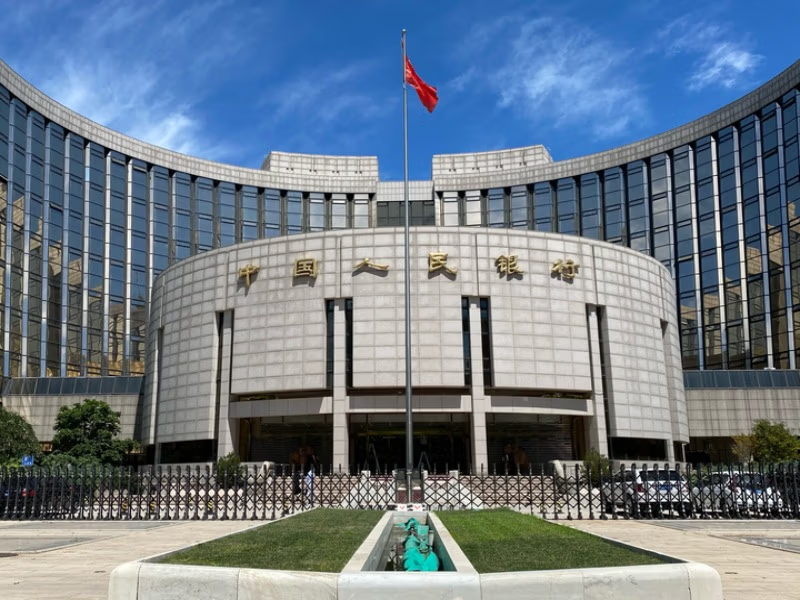
China’s central bank did not alter its benchmark lending rates on Tuesday, due to the balancing act of sustaining a decelerating economy while retaining the stability of its currency.
The People’s Bank of China maintained its 1-year and 5-year loan prime rates at 3 and 3.5 percent, respectively, in a tenth consecutive month of steady levels in the pace of sputtering economic growth.
Most of the new and outstanding loans are determined by the 1-year rate, which is the benchmark, and mortgages are determined by the 5-year level.
The second-largest economy in the world was seen to hit the brakes in the last quarter of last year, with its growth rate recording 4.5 percent year-on-year, the lowest growth rate since the nation lifted its strict Covid restrictions in late 2022.
The Chinese government has been unable to pull the economy out of an ingrained deflation due to consumers reducing their expenditure during a long-term real estate crash, a depressed labor market, and a profit-generating future.
The growth of retail sales was at its lowest point in 3 years at 0.9 percent in December, and the GDP deflator, a measure of changes in the prices of goods and services, remained negative in the last 11 consecutive quarters.
The policymakers have resorted to encouraging the consumption of services as a way of increasing total spending, as they hope services such as elderly care services, leisure, and tourism services will compensate for the sluggish goods demand.
According to LSEG data, the Chinese Yuan has maintained this recent development in recent months, with the offshore yuan stabilizing between 6.974 and 6.889 to the U.S. dollar at the beginning of the year to Tuesday morning, respectively.
In recent weeks, the PBOC has been indicating some flexibility around a slow appreciation of its currency, as the weakness of the dollar opens the door to the further pursuit of the yuan.
The central bank controls the yuan by having it within a band of 2 percent on either side of a midpoint, which it maintains every trading day. The officials have shifted their so-called fixing level downward, which dropped below the 7-mark at the end of January, the first time in almost three years.
An appreciation of the yuan would also challenge an already stressed export machine in the country with U.S tariffs, as exporters would be facing price pressures as a result of other manufacturing competitors.
Economists at ING project a shift of the fluctuation band of 6.85 to 7.25 this year as Beijing intends to advance the internationalization of its currency. The bank said, “The wildcard will be if the currency stability objective is softened in 2026.”