

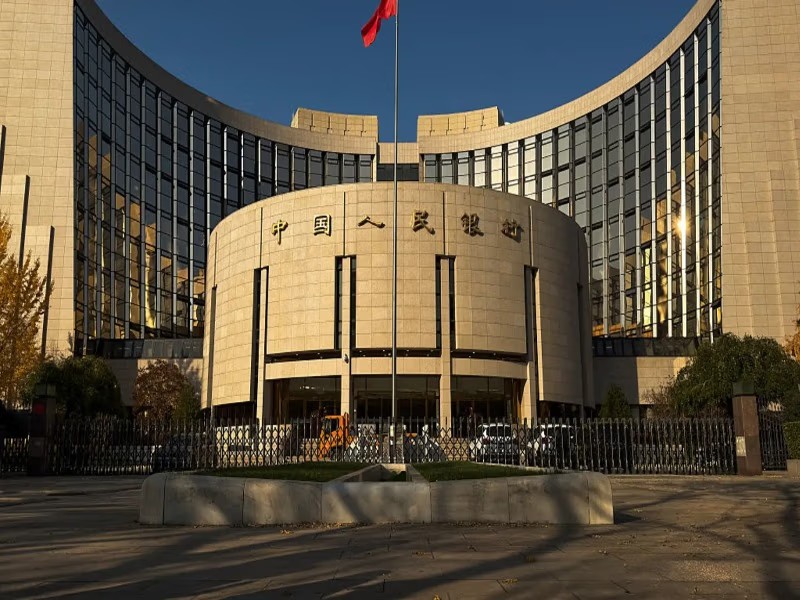
The central bank of China maintained its loan prime rates flat on Monday, even though the second-largest economy in the world has been recording poor economic statistics and a prolonged property sector slowdown.
Reuters reported that the People’s Bank of China maintained its 1-year and 5-year prime rates at 3 percent and 3.5 percent, respectively, for a seventh consecutive meeting.
Therefore, the 1-year rate serves as a yardstick for new loans, whereas the 5-year assists in pegging mortgage rates. This move by the PBOC follows the release of poor economic figures in China in November, including lower-than-expected retail sales and industrial output.
Retail sales increased 1.3 percent in the previous month compared to the same period in the previous year and missed the Reuters median growth projection of 2.8 percent, and were lower than the previous month by 2.9 percent.
The industrial production also fell short of expectations, rising 4.8 percent in November over a year earlier than it was estimated to increase by 5 percent, and the slowest growth since August 2024.
However, China is still recovering amid a prolonged downturn in the real estate market. Investment in fixed assets, such as property, shrank by 2.6 percent in the January to November quarter in comparison to the previous year, worse than the 2.3 percent decline projected by economists.
The prices of new homes also fell in November, reflecting the continuity of the weakness in the property sector in China. New home prices slipped 1.2 percent in tier-1 cities, including Beijing, Guangzhou, and Shenzhen, but resale home prices dropped 5.8 percent from a year earlier.
Professor of Trade Policy and Economics at Cornell University, Eswar Prasad, informed CNBC that on the subject of the 7-month lapse in monetary policy by the PBOC, he stated that “some stimulus will help,” but added that at a time when there’s been weakness in the private sector, “monetary policy probably won’t get that much traction.”
Prashad added, “With growth momentum weakening, they’re going to have to turn on the stimulus taps, some monetary stimulus, perhaps, and ideally a little more fiscal stimulus, but that really needs to be packaged with some broader reforms.”
Early this month, the finance ministry of China indicated that it would issue ultra-long-term special government bonds next year to finance the construction of major projects and new infrastructure projects.
Policymakers also promised to actively promote the use of special measures to stimulate consumption, in which the country struggles with deflationary pressures.
Even an interim trade agreement with Washington, in which the imposition of prohibitive rates of tariffs on Chinese exports was suspended, may assist the nation in achieving its 5 percent or so economic growth objectives in the year 2025 as the likelihood of higher shipments to the U.S. increases.
Meanwhile, Mainland China’s CSI 300 index surged to 0.43 percent on Monday. The onshore yuan remained flat at 7.04 against the dollar, although the offshore yuan fell slightly to trade at 7.03 against the greenback.