
Dow Jones Industrial Average and S&P 500 rose to new levels on Thursday, with a declaration of Federal Reserve interest rate cut and disappointing outcomes by Oracle, encouraging investors to shift away from high-technology shares and into companies that could gain advantages in an expanding U.S. economy.
The 30-stock Dow increased 646.26 points, or 1.34 percent, to close at 48,704.01, the new closing high. The index also recorded a new intraday high with the backing of an increase in Visa shares following the upgrade of the name at Bank of America.
Therefore, the broad market S&P 500 traded up 0.21 percent to settle at 6,901.00, which was also an ending record. Eventually, the Nasdaq Composite fell by 0.26 percent to end at 23,593.86.
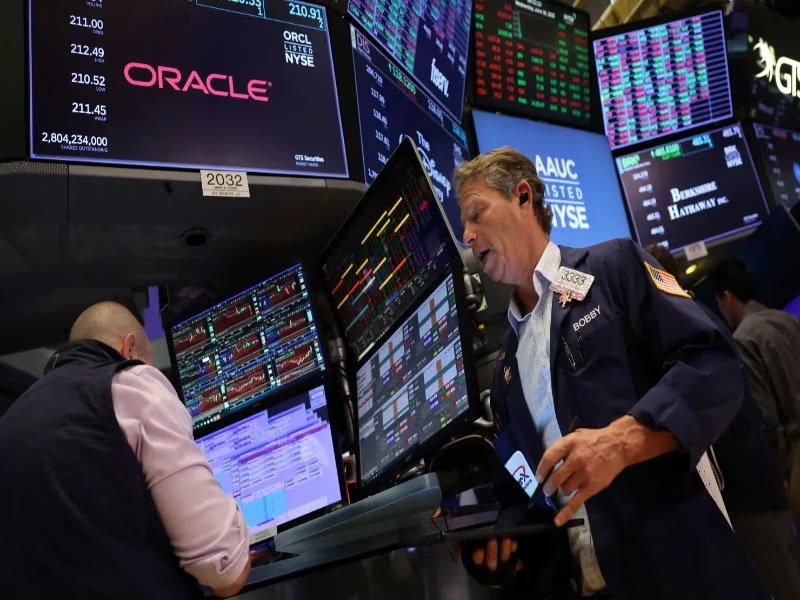
Oracle shares fell almost 11 percent after the cloud computing company reported poor quarterly revenue and increased its spending outlook, increasing worry over the debt in company.
The report further flamed the discussion concerning the pace at which tech firms could achieve a payoff on their artificial intelligence investments, which has prompted a rotation trade.
Other AI stocks were lower in trade, with Nvidia and Broadcom falling more than 1 percent each. In the meantime, cyclical shares such as Home Depot were up.
Chief Strategist at Interactive Brokers, Steve Sosnick said that “The market is properly concerned with Oracle and, by extension, with the AI trade in general, because there’s literally trillions of dollars of commitments out there, but there’s clearly a difficulty in figuring out how this is going to transpire, and Oracle, to some extent, is acting like the canary in the coal mine. The market’s right to rotate a little bit away from this.”
The negative trade sentiment dampened the momentum gained the day before when the S&P 500 nearly set another record as a split Fed declared an interest rate cut as the third this year. That puts its major overnight borrowing rate at a range of 3.5-3.75 percent. The central bank also denied any increase in the rates on the way.
As smaller firms are more likely than larger firms to gain more on low rates than large firms since their cost of borrowing is more closely tied to market rates, the Russell 2000 index of small-capitalization stocks reached new intraday and closing highs Thursday, along with the Dow.
The Russell 2000 had also entered the ranks of the three major indexes that saw an increase in the course of the Thursday session following the reduction in the Federal rate and even recorded an all-time high on the same day.
Meanwhile, Sosnick stated that the so-called Santa Claus rally “seems preordained” and may shoot the S&P 500 above the 7,000 mark.
However, he anticipates that there will be some pressure on the wider market in 2021, and he gives a 2026 year-end price target in the S&P 500 of 6,500. He mentioned AI headwinds and a new Fed chair, and the midterm elections as triggers of the downs.
The Chief Strategist informed CNBC that “Ultimately, I do have to be a bit concerned, because if the steam is coming out of the AI trade, there’s a lot of heavy lifting that has to be done by everything else. After three years of a huge bull market, there are, I think, some underappreciated risk elements.”