
A senior European Central Bank supervisor told Reuters that Eurozone banks face only a limited direct impact from the war in Iran, but the greater threat is that a weakened economy can contribute to the balance sheets of lenders.
Pedro Machado in an wide-ranging interview pointed out issues in the Middle East and in the recent wobble of the private market in a broad-ranging interview, as well as warned that a boom of complex securitisation deals bears closer inspection.
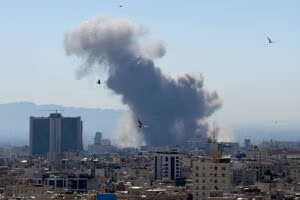
The risk of a new outbreak of a larger battle in the Middle East has increased the fears of another inflation spurt and renewed strain on expansion in the euro zone, which is familiar with the suppliers of the Gulf, some of its gas, and through the Suez Canal paths with its Asian traders.
Machado, who is among the ECB’s top bank watchdogs, explained that the direct exposure of eurozone banks to Iran and Israel was low, considering that they could absorb losses of 0.7 percent of core capital of assets, including those in the form of loans, and 0.6 percent of liabilities, including bank bonds.
In an interview, he said, “Even if you include neighbouring countries, the exposures are pretty contained, representing slightly less than 1% of supervised entities’ total assets.”
Biggest euro zone banks have assets worth 27.8 trillion euros ($32.32 trillion), as per the latest ECB data, meaning 1 percent of that would be worth 278 billion euros.
The greater risk, Machado said, in any new spurt in the energy prices, is their seeding into the inflation, and ultimately into a scramble that would squeeze borrowers.
Machado added, “In the long term, if we have energy prices heating up, we might have an inflation spike with recessionary potential impacts in terms of economic activity. And this translates into a potential impact on unemployment, which is a variable that is quite important for banks.”
Machado minimized the applicability to European lenders of the recent commotion in U.S. private credit, all at the flagship fund at Blackstone – citing that he had not seen “any particular evidence” of spillover.
However, he stated that the ECB was focusing more on synthetic securitizations, where banks would transfer the risks associated with their portfolios to external investors through derivatives or guarantees. Supervisors are concerned that the risk will not come back into the banking system via the indirect financing system.
He stated, “We intend to collect individual information on those transactions to then try to have a much more aggregate view on those, both in terms of volume but also in terms of potential exposure through the back door.”
Synthetic risk-transfer deals have been surging and increased 85 percent in the first half of 2025 compared to a year prior, with regulatory adjustments.