
Federal Reserve rate-cut expectations for 2025 shifted once again after the Federal Open Market Committee delivered a third consecutive quarter-point reduction, lowering the benchmark federal funds rate to 3.5 percent to 3.75 percent. The vote revealed the most significant internal disagreement since 2019, highlighting growing tension over whether inflation or labor market weakness poses the greater risk to the United States economy.
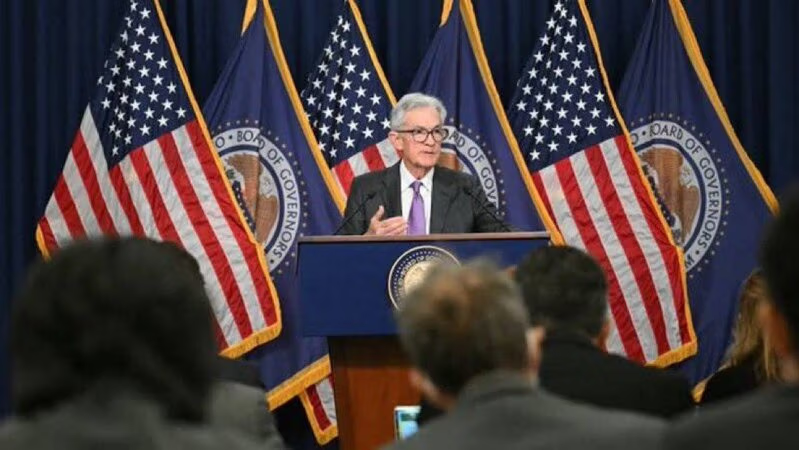
The committee also modified the language of its policy statement, signaling greater uncertainty about when further adjustments might occur. Chair Jerome Powell reinforced that caution during his press conference.
What the Fed Actually Did: A Quick Explainer
What is the federal funds rate?
It is the interest rate banks charge each other for overnight lending. It influences borrowing costs across the entire US economy, including mortgages, business loans, and credit markets.
Why do rate cuts matter?
Lower rates reduce financing costs and support economic activity, but they can also increase the risk of higher inflation. Central banks adjust rates to keep both growth and prices stable.
Why does this matter for the UAE?
The dirham is pegged to the US dollar, so changes in US interest rates directly affect borrowing costs in the UAE. Banks, mortgage holders, and investors all react to shifts in the Fed’s policy path.
Powell Signals Caution While Downplaying Risk of Future Hikes
Powell said the Fed’s latest action aims to support a labor market that has shown signs of softening while maintaining inflation pressure. “This further normalization of our policy stance should help stabilize the labor market while allowing inflation to resume its downward trend toward 2 percent once the effects of tariffs have passed through,” he said.
Asked whether the next move would definitely be another cut, Powell avoided making any commitments, though he noted that no official currently sees a rate increase as the base case.
Markets responded with a modest rally. The S&P 500 rose 0.7 percent, and ten-year Treasury yields eased to about 4.15 percent as investors recalibrated expectations. Traders now anticipate two cuts next year, down from the three previously expected.
Why Policymakers Are Split
Why were there dissents?
Three officials disagreed with the decision, the highest number since 2019. Their reasons differ:
• Two officials wanted no cut because inflation remains above target.
• One wanted a bigger cut because the labor market is weakening faster than expected.
What does this tell us?
The US economy is sending conflicting signals. Some data suggest cooling inflation, while other indicators show persistent price pressures. Rising unemployment adds another layer of complexity.
Three Dissents Signal Sharp Policy Divide
Chicago Fed President Austan Goolsbee and Kansas City Fed President Jeff Schmid voted to keep rates steady, while Governor Stephen Miran voted for a larger half-point cut. The split highlighted the challenge the committee faces in balancing risks.
The Fed also approved new purchases of short-term Treasuries beginning December 12 to ensure adequate bank reserves. Markets had widely expected this move as liquidity in overnight funding markets has tightened.
Conflicting Data Keeps Policy Path Uncertain
Unemployment reached 4.4 percent in September, up from 4.1 percent in June, strengthening the case for rate cuts. Inflation, however, increased 2.8 percent year on year, which is still above the Fed’s 2 percent target. A government shutdown has delayed several datasets, making the outlook more challenging to assess.
New York Fed President John Williams had stated publicly that he supported another cut in December, which played a key role in shaping market expectations ahead of the meeting.
Fresh Forecasts Show Split Outlook for 2026
Officials now expect only one interest rate cut in 2026 and one in 2027, based on the median projection. There is wide disagreement on that path. Seven officials prefer no cuts in 2026. Eight prefer at least two.
Growth forecasts for 2026 have improved to 2.3 percent from 1.8 percent. Inflation is projected to fall to 2.4 percent next year. Powell said tariff-related inflation should peak early in 2026 if no new tariffs are introduced.
Why tariffs matter:
Tariffs raise the cost of imported goods, which in turn feeds into inflation. Central banks often wait for tariff impacts to pass before adjusting policy aggressively.
Political Pressure Looms
The meeting came shortly after President Donald Trump said he would announce Powell’s successor early next year. The White House has repeatedly criticized the Fed for not cutting more quickly, raising concerns that central bank independence could be tested.
What Investors Should Watch Next
• How quickly inflation retreats in early 2026
• Labor market data, once delayed, resumes its releases resume
• Any new tariff actions that could alter the inflation path
• Signals from the next Fed chair nomination
• Liquidity effects from renewed Treasury purchases
For the UAE investors, shifts in the US policy outlook influence lending rates, equity flows, global risk sentiment, and the US dollar’s strength, all of which are closely tied to the local financial environment.