
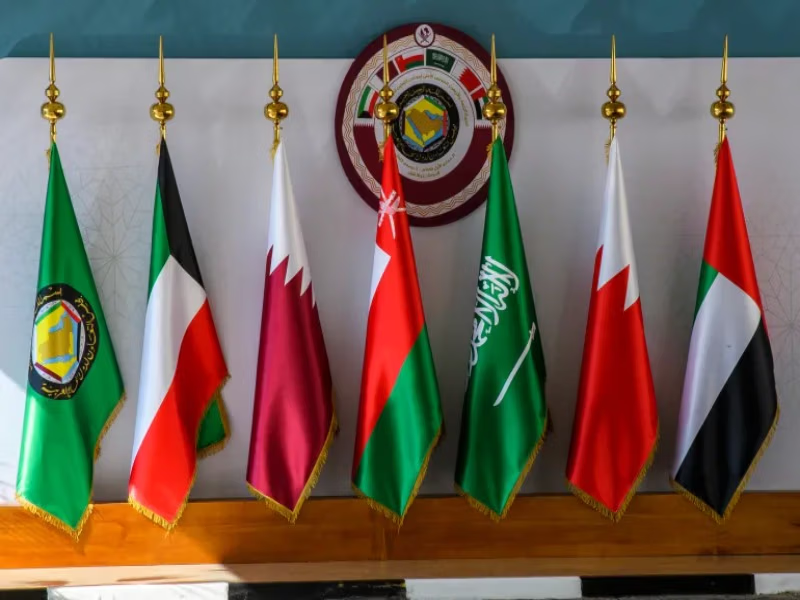
Saleh Al-Sharqi, Secretary-General of the federation, informed Al-Eqtisadiah that the Federation of GCC Chambers, together with the Customs Union Authority, plans to implement the Gulf Guarantee Project to offer a standardized system of exports and trade transactions and to streamline intra-GCC trade, which stood at approximately 146 billion by the end of 2024.
Al-Sharqi remarked on the peripheries of his meeting with media representatives in the headquarters of the federation in Dammam that the initiative is a qualitative leap in serving intra-GCC trade by enabling transit movement via a single point, and in reducing costs, increasing speed of goods flow, and contributing to the reliability of trade operations among the markets of the Gulf.
He stated that the federation has recently introduced a series of strategic initiatives, such as the Tawasul initiative, being used to reinforce communication between Gulf business owners and to facilitate the creation of trade and investment partnerships, and the Gulf Business Facilitation initiative, being used to see how the challenges facing Gulf investors and traders can be overcome, procedures simplified, and the business environment can be improved across the member states.
He pointed out that such initiatives come under an integrated vision to overcome the hurdles that limit the investment and intra-regional trade flows by establishing regulatory frameworks, opening channels of communication between the private and the public, and promoting the Gulf economic integration in accordance with the goals of the Gulf Common Market.
Similarly, the Secretary-General affirmed the orientation of GCC countries to use artificial intelligence technologies to facilitate the movement of trade and investment by emphasizing the necessity of forming a single Gulf committee on artificial intelligence to organize work and share experience between member states.
He reported that the federation will support this direction in the coming stage, drawing on leading international experiences, particularly the Chinese experience in this field.
During the recent electric railway initiative between Riyadh and Doha, Al-Sharqi announced that technical and advisory committees are in the process of finishing the required research in the project, stating that it will not only enhance the flow of passengers and freight between the two nations but also enhance the integration of the Gulf logistics, as well as supply chains within the region.
Concerning investment opportunities that can be extended to the Gulf nationals in the Syrian market he stated that the federation is liaising with the representatives of the private sector in Syria to eliminate the hindrances that may be met by the investigations of the Gulf investments, besides making efforts to extend suitable guarantees to safeguard such investments and to make the investment climate in Syria attractive and stable.
He responded to a question from Al-Eqtisadiah about the impact of tariffs imposed by the US on imports of iron, steel, and aluminum.
Al-Sharqi added that the GCC countries have economic and technical committees constantly monitoring the consequences of these tariffs on the Gulf private sector, determining the consequences of this development, and taking appropriate measures to ensure that it is not affected negatively.
Al-Sharqi also mentioned the establishment of two specialized committees in transport and logistics sector and in real estate activities, as they are the main pillars of economic diversification and a boost in the competitiveness of the GCC economies, their establishment is a pillar of economic diversification.
He further stated that the federation had over 40 meetings and official interactions with the Gulf and international organizations in the previous year, attended nine regional and international events to attain greater presence of the Gulf private sector in the global arena, and signed 12 agreements and memoranda of understanding with the Gulf, regional, and international to open new horizons in economic and investment cooperation.
The federation also launched four digital platforms in the same year to support the Gulf private sector, which now has eight digital platforms to serve the business community in the member states.
According to the Secretary-General, the federation will continue collaborating with other economic bodies in ensuring that processes and rules are harmonized, non-tariff trade barriers are lowered, and that mutual recognition of products and specifications is accelerated in a manner that facilitates the competitiveness of the Gulf economy and the further development of intra-GCC trade.