
The front rows of Paris fashion week are no longer just a playground for celebrity sightings. While the likes of Anya Taylor-Joy and Monica Barbaro chatted with ease, and Eugene Levy and Mike Feist found themselves largely unnoticed, the real buzz came from unexpected corners.
Lauren Sánchez Bezos turned heads in a powder-blue Dior skirt suit with a stunning fur-trimmed jacket, while Rihanna’s late arrival only heightened the excitement. Yet the most surprising guest of the day was none other than John Galliano. Once a celebrated figure at Dior, Galliano’s career took a dramatic turn after his 2011 firing. After years of rehabilitation and a successful tenure at Maison Margiela, he returned to Dior for the first time, bringing with him the weight of fashion history and the eyes of a curious crowd. Designer Jonathan Anderson, speaking ahead of the show, acknowledged Galliano’s influence: “When I was at university, John was God. He built Dior in the modern world. It felt really nice to have him back.”
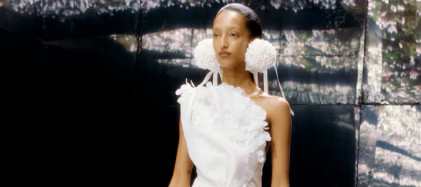
For Anderson, this couture debut was not just about the clothes—it was a statement of intent. Couture, often seen as a relic of opulence, found new life under his vision. The collection combined historical references with futuristic elements, marrying past Dior silhouettes with playful innovation. Micro-pleated silk georgettes swirled into bulbous skirts reminiscent of Marie Antoinette’s frocks, while oversized feathered tunics, delicate cashmere knits, and jacquard skirts gave the collection kinetic energy. Accessories stole the show as well, from poison-green raffia handbags to chain mail bags shaped like weasels, and alpaca stoles adorned with antique cameos.
Anderson’s approach emphasizes creativity over formula. His reinterpretation of Dior’s iconic hourglass silhouette through the lens of ceramicist Dame Magdalene Odundo brought a sculptural, almost kinetic feel to the classic curves. Even playful details, like snowball-sized cyclamen earmuffs inspired by Galliano’s gift, highlighted his ability to balance drama with whimsy.
For Anderson, Dior is a house with a storied past but boundless potential. He sees couture as both a platform for artistic expression and a commercial enterprise, where ideas can translate into desirability and value. Loafers with cameo motifs, collectible clutches, and elegantly draped stoles signaled a designer thinking about both spectacle and sales.
The response from the fashion world was immediate. Galliano, seated next to Anna Wintour, was swarmed by fellow designers, celebrities, and industry leaders, including Rihanna and Christian Louboutin, as the audience paid homage to a moment that felt like both a return and a rebirth.
In a week filled with headlines and high stakes, Jonathan Anderson’s Dior show stood out not for nostalgia, but for reinvention. It was a reminder that couture, when handled with vision and boldness, can still shock, delight, and redefine the boundaries of fashion.