

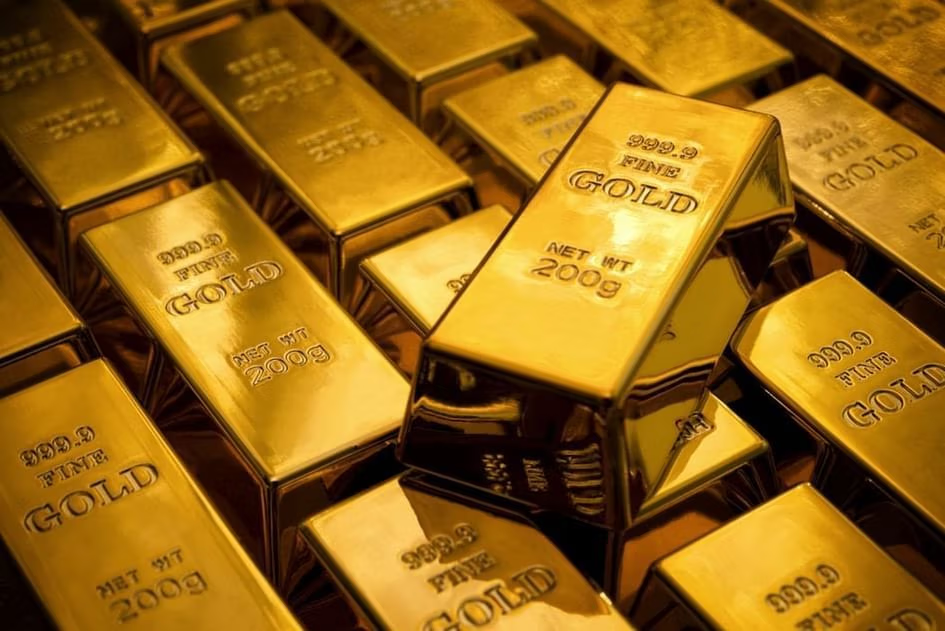
Gold price decline has taken global markets by surprise, with bullion witnessing one of its steepest weekly corrections in decades, challenging its traditional role as a crisis hedge.
The sharp drop comes at a time when geopolitical tensions are escalating, and financial markets are under pressure, conditions that would typically support gold prices. Instead, the metal has moved in the opposite direction, reflecting a broader shift in investor behaviour.
The recent correction highlights a notable shift in how investors position themselves during periods of uncertainty. Rather than flocking to gold, capital has increasingly moved toward liquidity and dollar-based assets.
The US dollar has strengthened significantly in recent sessions, attracting global flows and limiting upside in commodities. In parallel, elevated interest rates have reduced the relative attractiveness of non-yielding assets such as gold.
This evolving dynamic suggests that in the current cycle, liquidity and yield are taking precedence over traditional hedging strategies.
Another key factor behind the sell-off is the broader stress across asset classes. As equities and risk assets come under pressure, investors often liquidate profitable positions to meet margin requirements or rebalance portfolios.
Gold, which had delivered strong returns in the months leading up to the correction, has emerged as a source of funds during this phase of volatility.
Such liquidation-driven declines are typically sharp but short-lived, often disconnected from the asset’s underlying fundamentals.
Despite the magnitude of the fall, market participants do not view this as a structural breakdown in gold’s outlook.
Several long-term drivers remain intact:
- Persistent global inflation risks
- Continued central bank accumulation of gold reserves
- Ongoing geopolitical uncertainty
- Currency volatility across major economies
These factors continue to support the case for gold as a portfolio diversifier over extended time horizons.
For long-term investors, the correction is being interpreted less as a warning sign and more as a potential entry window.
Historically, sharp declines in gold during periods of forced selling have been followed by periods of stabilization and gradual recovery. Investors with a longer horizon may find value in staggered accumulation rather than attempting to time the exact bottom.
However, experts caution that near-term price action could remain volatile, particularly as global macro signals continue to evolve.
In the immediate term, gold is likely to remain sensitive to:
- Interest rate expectations
- Dollar strength
- Liquidity conditions in global markets
While the recent fall has disrupted sentiment, it has not fundamentally altered gold’s role in long-term asset allocation strategies.
For now, the gold price decline reflects more of a liquidity-driven adjustment than a shift in underlying demand, with investors recalibrating their positions in an increasingly complex global environment.