
Source : WAM
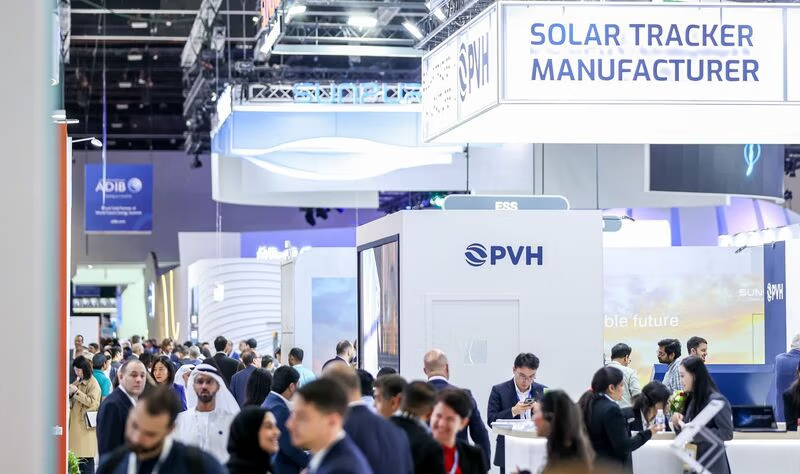
Greenpeace Middle East and North Africa (MENA) will take part in the World Future Energy Summit 2026 in Abu Dhabi from 13th to 15th January, contributing to discussions shaping the next phase of the region’s energy transition and beyond.
Representatives from Greenpeace MENA will provide evidence-based insights on how upstream decisions from product design and land use to capital allocation affect emissions, resource efficiency, and long-term resilience.
The organisation’s focus will be on practical strategies to reduce waste at the source, implement agrivoltaics land-use models for energy and food security, and leverage Islamic finance to drive renewable energy investment.
At the Summit, Greenpeace MENA will also participate in high-level panels, offering evidence-based perspectives on pressing energy and sustainability challenges.
One session, titled “Designed Out Waste: Breaking the Throw-Away Mindset,” will focus on shifting attention to the design phase of products and systems. The panel will challenge the notion that waste is inevitable, emphasizing durability, repairability, and end-of-life planning as essential for circular, low-carbon economies.
Greenpeace MENA will also host a session exploring agrivoltaics as a dual solution for clean energy and food security in the MENA region. Participants will examine how shared land-use models can support rural livelihoods while advancing climate goals, provided policies prioritise local ownership and equitable benefit-sharing.
On the Summit’s third day, Greenpeace MENA will lead “The $400 Billion Question: Where Islamic Finance Meets Renewable Energy,” a session exploring how Islamic finance can mobilise climate capital for renewable energy projects across the region.
“World Future Energy Summit provides an important platform for bringing diverse perspectives into dialogue,” said Ghiwa Nakat, Greenpeace MENA Executive Director.
Nakat added, “As energy systems across the region continue to evolve, it is essential to look beyond capacity and scale, and consider how design choices, land use, and financial frameworks shape long-term outcomes. Our participation at WFES reflects our commitment to engaging constructively in these conversations by contributing verified findings and practices grounded in real-world experience.”
In addition to panels, Greenpeace MENA will host a dedicated Greenpeace MENA Cinema on the exhibition floor throughout the three-day event, in collaboration with the Summit.
The cinema will offer visitors a curated, headphone-based film experience, allowing them to reflect on how sustainability commitments translate into action. Through immersive visual storytelling, attendees can engage with content at their own pace, even amid the busy show floor.
“At World Future Energy Summit, we know that awareness doesn’t come from panels alone,” said Sophia Sheikh, Content and Marketing Director, World Future Energy Summit. “That’s why we are creating multiple content formats across the event, from high-level debates to immersive, visual storytelling, including the Greenpeace Cinema, which offers visitors a moment to pause, reflect, and engage with sustainability narratives in a more personal and human way. “
Greenpeace MENA’s participation at WFES 2026 highlights the Summit’s role as a platform where governments, industry, finance, and civil society can collaborate on practical aspects of energy leadership, innovation, and future readiness.