

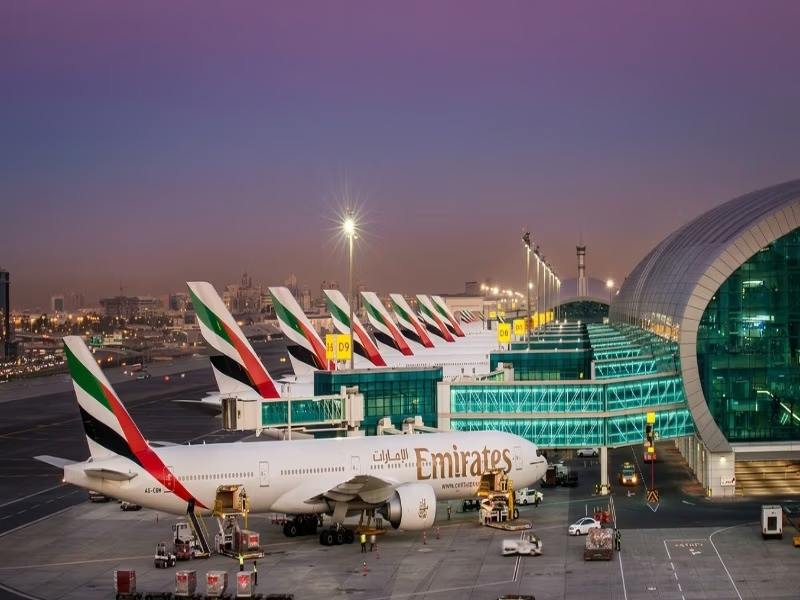
Emirates and Etihad Airways resumed limited flight operations after parts of the Middle Eastern airspace reopened, while Qatar Airways started operating a limited flight schedule to and from Doha under restricted conditions.
The progressive recovery comes after days of disturbance caused by military tensions between the US, Israel, and Iran that created a need to close airspace over much of the region, disrupted major international aviation routes, and caused thousands of cancellations and diversions.
Qatar Airways announced that flights were operating only for passengers whose final destination was Doha, indicating continued airspace restrictions even as parts of the region reopened.
Emirates, in a statement, said that any customer traveling via Dubai would only be allowed to travel on the condition that their connecting flight was in operation.
The airline stated, “Emirates continues to monitor the situation, and we will develop our operational schedule accordingly.”
Etihad added that it restarted a limited commercial flight program on March 6 to selected destinations following safety reviews conducted with relevant authorities.
The airline added in a statement on March 6, “The decision has been taken in coordination with relevant authorities following extensive safety and security assessments. Etihad continues to monitor the situation closely and will only operate flights once all safety criteria are met.”
According to aviation analytics firm Cirium, the three carriers comprising the majority of the passengers in the region have been impacted by the disruption, and the three hub airports of Dubai, Abu Dhabi, and Doha typically receive approximately 90,000 passengers daily.
Fitch Ratings added that the time of aviation disruption after the February 28 strikes of Israel and the US on Iran and the subsequent retaliation of Iran across the region would play a leading role in impacting the aviation industry, such as airlines, airports, hospitality, insurance, and aircraft leasing.
“Our baseline expectation that the conflict in the Middle East will last less than a month should limit the implications for Fitch-rated issuers in sectors affected by the aviation disruption,” Fitch said, citing that a prolonged disruption would add greater risks, especially for smaller and less diversified operators.
Fitch reports that more than 15,000 flights were canceled in seven major regional airports between Feb. 28 and March 5, impacting over 1.5 million passengers. It also diverted some of the flights to European airports.
The ratings agency reported that airlines that had hubs in directly impacted countries experienced the most significant revenue risk, especially in the UAE and Qatar, and other airline companies were impacted by the halted routes and the necessity to avoid restricted airspace.
It added, “The highest volume exposure among Fitch-rated EMEA (Europe, the Middle East and Africa) network airlines to the broader Middle East region does not exceed a high single-digit percentage.”
The report also indicated that the disruption was raising operating expenses due to aircraft having to take longer routes, making extra technical stopovers, and bearing overtime on crew, as well as increasing accommodation and ground-handling expenses.
Passenger compensation will be minimal since there is no way for airlines to take control of the conflict, but airlines can be subjected to expenses of meals, accommodation, refunds, or travel vouchers due to flight cancellations.
Simultaneously, the interruption typically results in the increased cost of tickets on impacted and neighboring flights, which are beneficial in partially covering the financial impact.
Besides loss of revenue, the airlines will also experience the pressure of increased fuel prices. The overall fuel-hedging position of most carriers in Europe, the Middle East, and Africa, and in the Gulf, remains rather robust, with most covering periods of the next three months usually covering between 50 percent and over 80 percent.
The report added that “The impact on Fitch-rated European airports is likely to be mixed, with lost revenue from declining point-to-point traffic from the Far East and the knock-on effect on retail spending per passenger, potentially offset by higher ancillary revenues such as parking fees, and, where applicable, regulatory protection against traffic volatility.”