

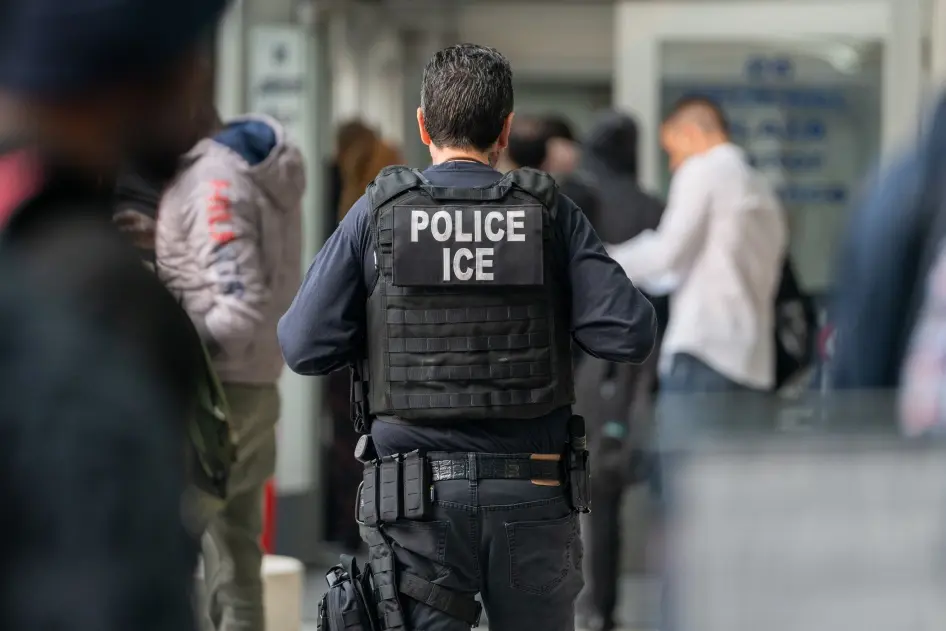
The fatal shooting of a Minneapolis woman during an immigration enforcement operation has reignited a national debate over the role, reach and accountability of U.S. Immigration and Customs Enforcement (ICE), an agency now at the centre of President Donald Trump’s renewed push for mass deportations.
The death of 37-year-old Renee Nicole Good, a U.S. citizen, has sparked protests across multiple cities and intensified scrutiny of ICE’s tactics, particularly as the agency ramps up arrests in public spaces under Trump’s second term.
Since Trump returned to the White House in January 2025, ICE has carried out thousands of arrests nationwide, often in high-visibility operations that have increasingly drawn opposition from local communities, activists and state officials.
What Is ICE And Why Was It Created?
ICE is the primary federal agency responsible for enforcing US immigration laws and conducting investigations into undocumented immigration.
It was established under the Homeland Security Act of 2002, passed in response to the 11 September 2001 terrorist attacks, which created the Department of Homeland Security (DHS). ICE became one of DHS’s subsidiary agencies, alongside US Customs and Border Protection (CBP).
Under Trump, ICE has taken the lead in implementing the administration’s mass deportation initiative, a central campaign promise. Since January 2025, the White House has expanded ICE’s budget, staffing, and operational scope, positioning it as a cornerstone of the administration’s domestic security agenda.
What Powers Do ICE Agents Have to Arrest People?
ICE agents have broader authority than many realise, but their powers are not unlimited.
Agents may stop, detain and arrest individuals they suspect of being in the U.S. illegally. However, entry into a private home or non-public space generally requires a signed judicial warrant.
ICE agents can detain U.S. citizens only in limited circumstances, for example, if someone interferes with an arrest, assaults an officer, or is suspected of being in the country unlawfully.
Despite those restrictions, ProPublica reported that during the first nine months of Trump’s presidency, there were more than 170 incidents in which federal agents held U.S. citizens against their will, including Americans mistakenly suspected of being undocumented immigrants.
When Can ICE Use Deadly Force?
ICE’s use-of-force policies are governed by the U.S. Constitution, federal law, and DHS guidelines.
However, the U.S. Supreme Court has historically given officers wide latitude in split-second decisions, limiting accountability after the fact.
A 2023 DHS policy memo states that federal officers “may use deadly force only when necessary” and only when they have “a reasonable belief” that a person poses an imminent threat of death or serious bodily injury.
In Minneapolis, Good was killed while sitting behind the wheel of her car. The Trump administration says the ICE agent acted in self-defence, while local officials dispute that claim, insisting she posed no danger.
The case has escalated into a political confrontation, with Minnesota officials suing the administration to block the deployment of federal immigration agents in the state.
Where Does ICE Operate?
ICE primarily operates inside the United States, though it maintains staff overseas. Traditionally, U.S. Customs and Border Protection has handled border enforcement, while ICE focused on interior operations.
That distinction has blurred under Trump.
The administration has redeployed agents from across federal law enforcement to assist with immigration enforcement. Border Patrol officers are now routinely operating deep inside the US, conducting raids alongside ICE.
As of January 14, officials told CBS News that around 2,000 agents from ICE and other federal agencies had been deployed to Minneapolis, alongside an additional 800 CBP officers. Similar deployments have occurred in Los Angeles and Chicago.
What Happens After Someone Is Detained?
The scale of deportations under Trump’s second term has been significant.
The administration says it deported 605,000 people between 20 January and 10 December 2025, while 1.9 million immigrants “voluntarily self-deported” following an aggressive government campaign urging people to leave to avoid detention.
Those who encounter ICE may be briefly questioned and released — or transferred to one of several ICE detention centres across the country.
As of November 30, 2025, about 65,000 people were being held in ICE detention, according to data from the Transactional Records Access Clearinghouse (TRAC) at Syracuse University.
Immigration lawyers told the BBC that once someone is detained, families and legal representatives can sometimes wait days to locate them.
Rising Resistance and Clashes With Communities
ICE operations have increasingly been met with resistance.
Residents frequently film arrests, and encounters with protesters have at times turned aggressive. In Chicago, a coalition of media organisations sued the Border Patrol, alleging agents used improper force against journalists, religious leaders and protesters. A federal judge initially sided with the group, though an appeals court later overturned the ruling.
Good’s death was followed by further violence. DHS confirmed that an ICE officer shot a Venezuelan man in the leg in Minneapolis days later during what it described as a “targeted traffic stop,” alleging the man resisted arrest and assaulted an officer.
The Los Angeles Times also reported two October incidents in which agents fired at drivers. DHS said officers were threatened with vehicles in both cases.
ICE agents have drawn criticism for wearing masks during operations. DHS has defended the practice as protection against doxxing and harassment.
Where Do Americans Stand?
Public opinion on immigration enforcement remains divided.
An October 2025 Pew Research Center survey found that just over half of Americans believe some level of deportation is necessary, roughly unchanged from earlier in the year.
But 53% of U.S. adults said the Trump administration was doing “too much” to deport undocumented immigrants, while 36% supported the approach.
As ICE expands its reach and visibility, the political, legal and social costs of that strategy are becoming harder to ignore.