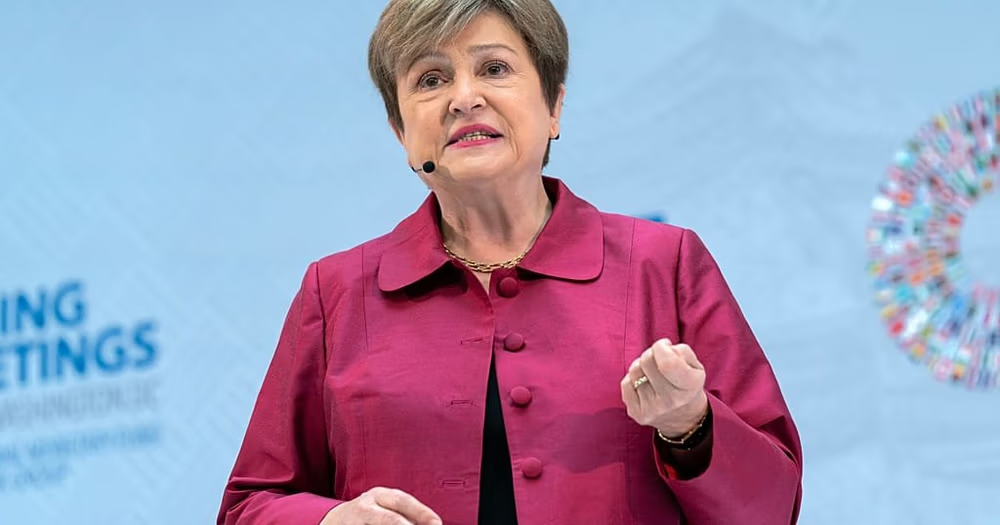
IMF’s Managing Director Kristalina Georgieva has warned that a prolonged conflict in the Middle East could significantly worsen the global economic outlook, with rising inflation and slower growth becoming increasingly likely if disruptions persist through 2027.
Speaking on Monday, Georgieva said the IMF’s earlier baseline assumption of a short-lived conflict is no longer realistic. The Fund had initially projected global growth of 3.1 percent and inflation of 4.4 percent under a limited-disruption scenario.
“That scenario, with every day that passes, is further and further behind in the rear-view mirror,” she said.
Instead, the IMF now sees conditions aligning more closely with its “adverse scenario,” which assumes sustained geopolitical tensions, elevated oil prices, and mounting inflationary pressures. Under this framework, global growth is expected to slow to 2.5 percent in 2026, with headline inflation rising to 5.4 percent.
Georgieva cautioned that risks could intensify further if the conflict extends into 2027, particularly if oil prices approach $125 per barrel. In such a case, the global economy could shift toward what the IMF describes as a “severe scenario,” with growth slowing to around 2 percent and inflation climbing to 5.8 percent.
“Now, if this continues into 2027 and we have oil prices of $125 more or less, then we have to expect a much worse outcome,” she said. “Then we are going to see inflation climbing up, and inevitably inflation expectations would start de-anchoring.”
The warning underscores the central role of energy markets in shaping the global outlook. Supply disruptions linked to the conflict have already pushed oil prices higher, feeding into broader inflation concerns and complicating monetary policy decisions.
At the same event, Mike Wirth, Chairman and CEO of Chevron, highlighted the risks to global oil supply, particularly if shipping routes remain disrupted. He noted that the closure of the Strait of Hormuz, through which roughly 20 percent of global crude supply typically passes, could lead to physical shortages in energy markets.
Wirth said such constraints would likely have a cascading effect on global growth, with Asian economies particularly vulnerable as supply tightens and demand adjusts downward.
Beyond energy, the IMF is also tracking secondary impacts across global supply chains. Georgieva noted that fertilizer prices have already risen by 30 percent to 40 percent, a development that could push food prices up by 3 percent to 6 percent. Additional sectors could face similar pressures as costs increase and ripple through production systems.
Despite the mounting risks, long-term inflation expectations have so far remained relatively stable, and financial conditions have not tightened significantly. However, Georgieva warned that this balance could shift quickly if the conflict continues and supply shocks intensify.
She also expressed concern that policymakers may be underestimating the crisis’s duration and severity, cautioning against measures that sustain high demand amid constrained supply.
“Don’t throw gasoline on fire,” she said. “If your supply shrinks, your demand has to follow.”
The IMF’s latest assessment reflects growing unease among global institutions as geopolitical tensions intersect with fragile economic conditions, raising the stakes for policymakers navigating an increasingly uncertain environment.