

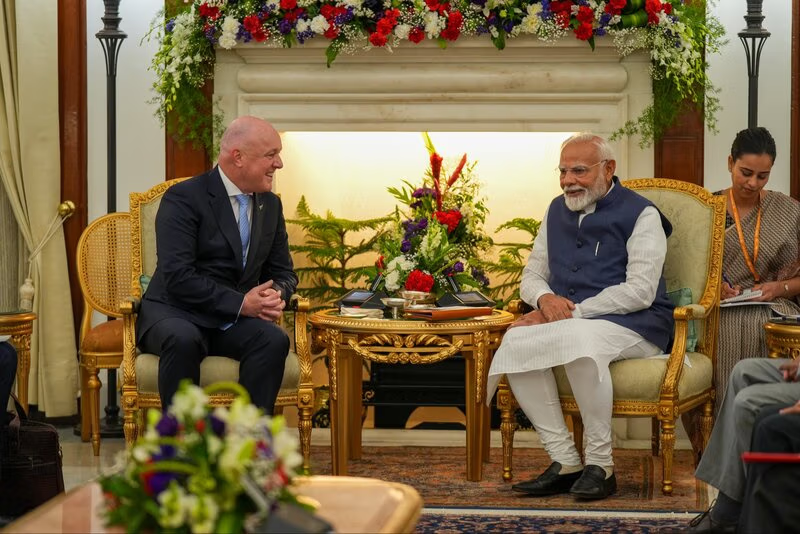
India and New Zealand have finalized a landmark free trade agreement (FTA), marking the culmination of over a decade of negotiations and signaling a significant step forward in their economic partnership.
Described as a “once-in-a-generation” deal by New Zealand Prime Minister Christopher Luxon, the agreement is designed to boost bilateral trade, expand investment flows, and deepen economic integration between the two countries.
Just over a year ago, I met with Prime Minister Modi in India.
— Christopher Luxon (@chrisluxonmp) April 27, 2026
We agreed then, that we’d launch negotiations on a free trade agreement. For decades, many people said it couldn’t be done. But tonight, that deal gets signed.
This is a once-in-a-generation agreement that gives NZ… pic.twitter.com/miY4ldfXM5
The pact provides for duty-free access for 100 percent of Indian exports to New Zealand, removing tariffs across thousands of product categories and opening up new opportunities for Indian manufacturers and exporters. In return, India will reduce or eliminate tariffs on around 95 percent of New Zealand’s exports, including key sectors such as wool, wood, coal, wine, and agricultural products.
The agreement is also expected to double bilateral trade to around $5 billion over the next five years, while attracting an estimated $20 billion in investment into India over a 15-year period. This aligns with India’s broader strategy to diversify export markets and reduce dependence on a limited set of trading partners amid global economic uncertainty.
Negotiations for the deal had originally begun in 2010 but stalled in 2015 before being revived in 2025. The renewed talks progressed rapidly, culminating in a comprehensive agreement that spans goods, services, and investment.
Beyond tariff reductions, the FTA includes provisions to improve market access, facilitate trade in services, and enhance labor mobility, creating new opportunities for professionals and businesses in both countries.
For India, the agreement is expected to benefit sectors such as textiles, leather, pharmaceuticals, and engineering goods, while also opening avenues for small and medium enterprises to expand into the Oceania market. For New Zealand, improved access to the Indian market is likely to support exports of agricultural and forestry products and strengthen its trade footprint in one of the world’s fastest-growing major economies.
At the same time, sensitive sectors have been carefully protected under the agreement, reflecting a calibrated approach to trade liberalization that balances growth opportunities with safeguards for the domestic industry.
The deal also fits into a broader geopolitical and economic context, as India accelerates its free-trade-agreement strategy to strengthen its position in the Indo-Pacific and integrate more deeply into global supply chains.
With implementation expected in the coming months, the India-New Zealand FTA is being seen as a defining moment in bilateral relations, setting the stage for stronger trade flows, increased investment, and deeper economic cooperation in the years ahead.