
India and the United States have released a framework for an interim trade agreement that lowers tariffs on Indian exports and reopens negotiations on a broader bilateral deal. The announcement has triggered political backlash in New Delhi, market interest globally, and fresh questions about energy, geopolitics and supply chains.
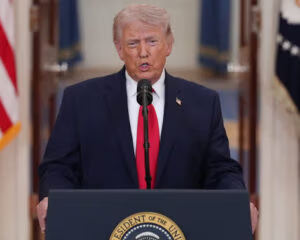
The joint statement was released on Friday, days after U.S. President Donald Trump said Washington would reduce import tariffs on Indian goods. That move followed months of pressure on India to curb its purchases of discounted Russian crude oil.
Tariffs Cut as Oil Policy Shifts
Under the framework, tariffs on Indian goods entering the United States will be reduced to 18 percent from 25 percent, according to President Trump. The reduction comes after Prime Minister Narendra Modi agreed to stop buying Russian oil, Trump said.
The agreement was described by both governments as “reciprocal and mutually beneficial.” The statement added that further negotiations are required before the deal is formally finalised.
On Friday, Trump also signed an executive order revoking a separate 25 percent tariff on Indian goods that he imposed last year.
What India Agreed To
India has committed to eliminating or reducing tariffs on all U.S. industrial goods and a wide range of food and agricultural products, according to the joint statement.
Trump said India would begin lowering import taxes on US goods to zero and would buy 500 billion dollars worth of American products over five years. The proposal is part of the administration’s broader push for zero tariffs on most US exports and deeper access to large foreign markets.
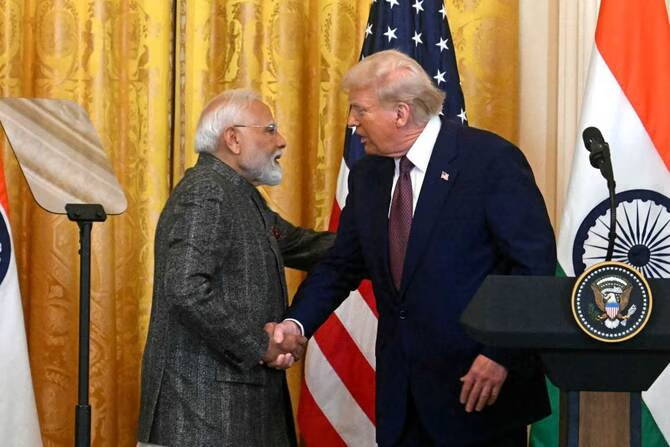
Prime Minister Modi welcomed the agreement publicly.
“Thank you for your personal commitment to robust ties,” Modi wrote, adding that the framework “reflects the growing depth, trust and dynamism of our partnership” and would “further deepen investment and technology partnerships between us.”
Political Backlash at Home
India’s opposition parties have criticised the deal, arguing that it disproportionately favours the United States and risks harming politically sensitive sectors such as agriculture.
Agriculture and dairy employ a large share of India’s workforce. New Delhi has historically resisted opening these sectors to foreign competition.
Trade Minister Piyush Goyal pushed back against the criticism, saying the agreement safeguards core domestic interests.
The deal protects “sensitive agricultural and dairy products,” including maize, wheat, rice, ethanol, tobacco and certain vegetables, Goyal said.
Export Gains and Jobs Promise
Goyal said the agreement would open access to what he described as a 30 trillion dollar U.S. market, referring to America’s annual GDP.
“This will open a $30 trillion market for Indian exporters,” he said in a social media post, adding that higher exports could create hundreds of thousands of new jobs.
He also said tariffs would fall to zero on a broad range of Indian exports to the U.S., including generic pharmaceuticals, gems and diamonds, and aircraft components. These categories are among India’s most competitive global exports.
Strategic Context Matters
The trade framework comes as India accelerates efforts to diversify trade ties beyond China and Russia.
India recently concluded a long-awaited free trade agreement with the European Union after nearly two decades of negotiations. That deal covers almost all goods traded between India and the EU’s 27 member states, including textiles, medicines, wine and automobiles.
New Delhi also signed a comprehensive economic partnership agreement with Oman in December and completed negotiations for a free trade deal with New Zealand.
For Washington, the interim deal with India fits into a broader strategy of reshaping supply chains, reducing reliance on adversarial energy sources and securing market access in fast-growing economies.
For investors and exporters, the next phase will matter more than the announcement itself. The framework sets direction. The details will determine the impact.