

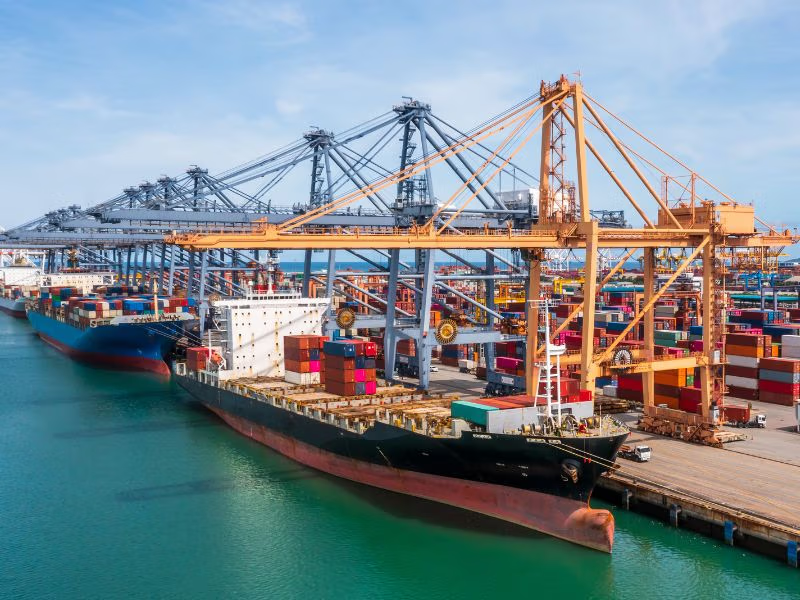
Saudi Arabia’s non-oil exports recorded a strong jump in October, highlighting the Kingdom’s steady progress toward economic diversification under Vision 2030. Official data reportedly shows that non-oil exports, including re-exports, rose sharply year on year, reflecting expanding trade activity beyond crude oil.
How much did non-oil exports grow?
According to preliminary data from the General Authority for Statistics (GASTAT), Saudi Arabia’s non-oil exports, including re-exports, increased by 32.3% year on year in October, reaching SR33.88 billion ($9.03 billion).
When re-exports are excluded, national non-oil exports still grew by 2.4% compared to October last year. This growth helped improve the trade balance, with the ratio of non-oil exports to imports rising to 42.3%, up from 33.4% a year earlier.
Why is this growth important
The rise in non-oil exports supports Saudi Arabia’s Vision 2030 goal of reducing dependence on oil revenues. Strong performance in manufacturing, logistics, and trade shows that diversification efforts are translating into measurable results. Moody’s has also noted that Saudi Arabia is on track to maintain 4.5%–5.5% annual growth in its non-oil economy over the next decade as reforms continue.
Re-exports were a major driver of October’s performance. GASTAT reported that the value of re-exported goods jumped 130.7% year on year. This surge was largely due to a massive increase in transportation equipment and parts, which rose 387.5% and accounted for 37.4% of total re-exports.
Which sectors led non-oil exports?
The leading non-oil export category was machinery and electrical equipment, including parts, which made up 23.6% of total non-oil exports and grew 82.5% year on year. Chemical products followed, contributing 19.4% of non-oil shipments. These figures underline the growing importance of industrial and value-added sectors in the Kingdom’s export mix. China remained the top destination for Saudi non-oil exports, receiving goods worth SR14.68 billion. Other major destinations included: UAE: SR11.37 billion, India: SR10.25 billion, Japan: SR8.37 billion, South Korea: SR7.37 billion. The US, Bahrain, and Egypt were also key markets for Saudi non-oil products.
Ports also played a critical role in facilitating trade.
In October, Jeddah Islamic Seaport handled non-oil exports worth SR3.76 billion, Ras Al Khair Seaport: SR3.64 billion, King Fahad Industrial Seaport (Jubail): SR3.21 billion, and other important gateways included Jubail Seaport, Ras Tanura, and King Abdulaziz Seaport in Dammam.
Saudi Arabia’s total merchandise exports reached SR103.98 billion in October, an 11.8% increase year on year.
The share of oil exports declined to 67.4%, down from 72.5% a year earlier, signaling a gradual shift toward a more balanced export structure.
China remained the Kingdom’s largest overall export destination, followed by the UAE and India. The top 10 destinations accounted for more than 70% of total exports.
Imports rose 4.3% year on year to SR80.07 billion in October. Despite this, the merchandise trade surplus surged 47.4%, supported by stronger export growth.
China was the largest source of imports, followed by the US and the UAE. Sea routes remained the main entry channel, with King Abdulaziz Seaport in Dammam leading inbound shipments.