
Caracas was asleep when the explosions began just after 2 a.m. local time on Saturday. Loud blasts echoed across the Venezuelan capital, and low-flying aircraft roared overhead. Meanwhile, parts of the city lost power.
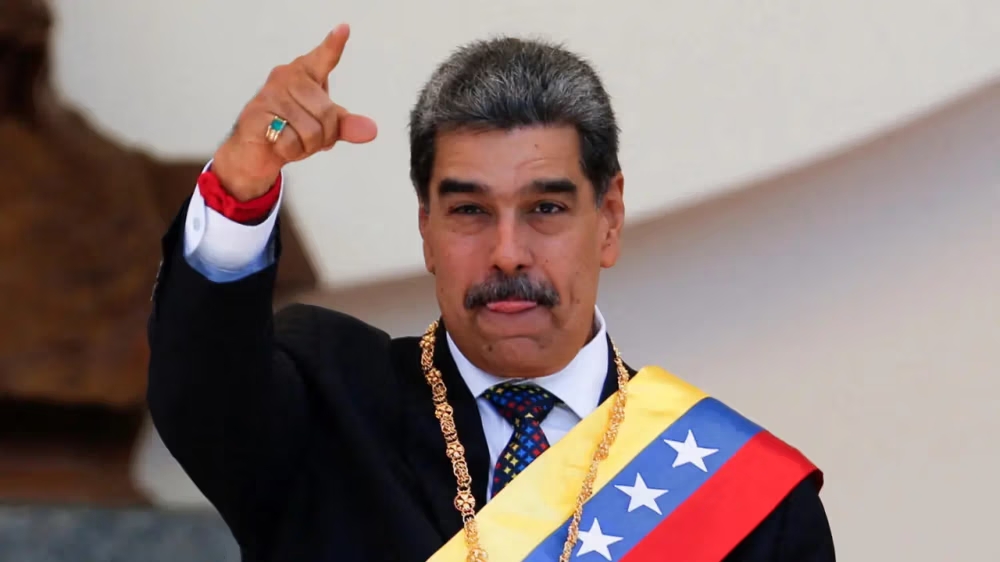
By dawn, Venezuela was in a state of emergency. With the shine of the sun, the world was confronting an unverified but explosive claim. Donald Trump said the U.S. had captured President Nicolás Maduro. If confirmed, it would mark one of the most dramatic U.S. interventions in Latin America in decades.
What Did People in Caracas Hear?
At least seven explosions were reported across Caracas in the early hours, according to eyewitnesses cited by the BBC.
Residents described aircraft flying unusually low over the city. Smoke was seen rising from the hangar of a military base. Another military installation was left without electricity.
Two sensitive military sites appeared to be affected. One was La Carlota airbase, located in central Caracas. The other was Fuerte Tiuna, the country’s main military complex.
People poured into the streets in several neighbourhoods.
Trump’s Claim: Maduro Captured
Hours after the explosions, Donald Trump posted a statement on Truth Social.
He said the United States had carried out a “large-scale strike” against Venezuela. He claimed that President Nicolás Maduro and his wife had been captured and flown out of the country.
Trump said the operation was conducted alongside U.S. law enforcement. He promised further details at a press conference scheduled for 11 a.m. at Mar-a-Lago.
No evidence was released. Venezuelan authorities have not confirmed the claim.
Caracas Responds: “Military Aggression”
Before Trump announced the capture, Venezuela’s government issued a strong condemnation.
It described the events as an “extremely serious military aggression” by the United States. Officials said the attack violated Venezuelan sovereignty and endangered civilians.
President Maduro declared a state of emergency shortly after.
Venezuela’s Vice President, Delcy Rodríguez, later said the government did not know the whereabouts of Maduro or First Lady Cilia Flores. She demanded immediate proof of life for both.
Why Is Washington Targeting Maduro?
Trump has long accused Maduro of running a narco-state.
He has labelled the Venezuelan leader a “narco-dictator” and linked him to the so-called Cartel de los Soles. Analysts say the term refers to corrupt networks inside the Venezuelan state rather than a single organised cartel.
The US government argues that Venezuelan drug networks threaten American national security. Venezuela, however, is considered a minor transit route for drugs compared with other countries.
Washington has offered a $50 million reward for information leading to Maduro’s arrest.
Trump has also blamed Maduro for rising migration into the United States. Nearly eight million Venezuelans have fled the country since 2013, according to the BBC.
Trump has claimed, without providing evidence, that Maduro emptied prisons and mental health facilities and sent inmates north.
Maduro has repeatedly denied these allegations.
Oil, Power, and the Real Stakes
Maduro has accused the United States of using the war on drugs as a cover.
He says Washington’s true goal is regime change and access to Venezuela’s oil. The country holds the largest proven oil reserves in the world.
That reality makes every military move more than symbolic.
Energy markets, emerging market investors, and regional governments are watching closely.
The Pressure Campaign Before the Strikes
Tensions between Washington and Caracas have been building for years. They intensified sharply during Trump’s second presidency.
The U.S. expanded naval patrols in the Caribbean. It deployed warships closer to Venezuelan waters.
In late October, the Pentagon rerouted the USS Gerald R. Ford to the region. The carrier brought roughly 5,000 personnel closer to Venezuela.
More than 15,000 U.S. troops are now deployed across the Caribbean. It is the largest American military presence there in decades.
In early December, Trump designated Venezuela a foreign terrorist organisation. He also ordered a blockade of US-sanctioned oil tankers servicing the country.
On December 29, Trump said the U.S. destroyed a docking area used by alleged Venezuelan drug boats. He did not say where the strike occurred or which agency carried it out.
What Comes Next?
The situation is unfolding by the hour. Maduro’s location remains unknown. The U.S. has not released proof of his capture.
Sources in the Venezuelan opposition told Sky News that the operation may have been part of a negotiated exit between Maduro and Washington. That claim has not been independently verified.
What is clear is this.
If Maduro has been removed, Venezuela enters uncharted territory. If he has not, the risk of further escalation remains high.
Either way, the shockwaves will not stop at Venezuela’s borders.