
The conflict in the Middle East intensified sharply over the weekend, with Iran claiming it had downed two U.S. warplanes even as Israeli forces expanded airstrikes into Lebanon, underscoring the widening scope of a confrontation that is increasingly spilling across borders.
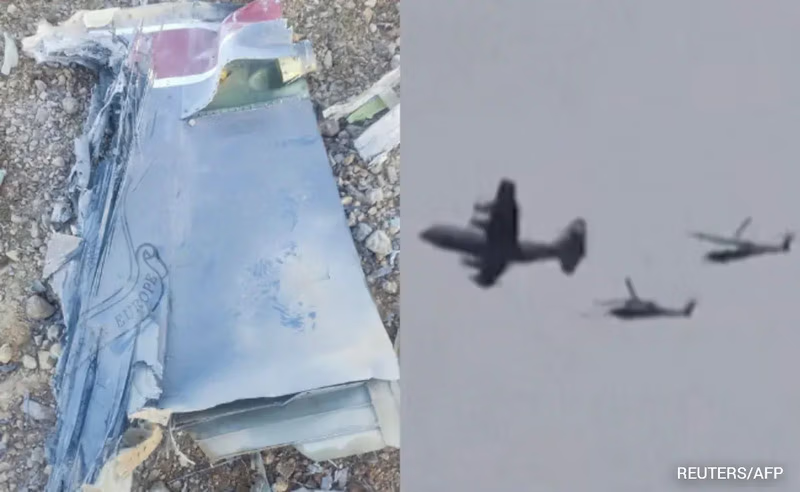
Tehran said its air defense systems intercepted American aircraft operating near its territory, with reports suggesting one jet was brought down and another lost in the broader Gulf region. U.S. officials have yet to fully confirm the claims, but have acknowledged an ongoing search-and-rescue operation for personnel linked to a downed aircraft.
If verified, the incident would mark one of the most direct military confrontations between Iran and the United States in recent years, raising the risk of further escalation at a time when tensions are already running high.
The developments come as Israel steps up its campaign against targets in Lebanon, striking infrastructure, including bridges and transport links, in what appears to be an effort to disrupt supply routes and limit the movement of armed groups along its northern frontier.
The expansion into Lebanon reflects a broader shift in the conflict, which is no longer confined to a single theatre. Instead, it is evolving into a multi-front confrontation involving state and non-state actors across the region.
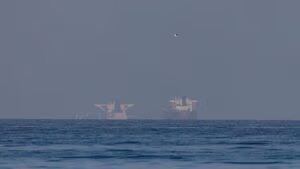
For markets, the escalation is being closely watched through the lens of energy security. The Strait of Hormuz, a critical artery for global oil shipments, remains under pressure, with any sustained disruption likely to have immediate implications for crude prices and global inflation.
The latest developments also highlight the growing role of asymmetric warfare. Iran’s ability to challenge advanced military assets, whether through air defense systems or proxy capabilities, adds a new layer of complexity to the conflict and heightens the risk of miscalculation.
Diplomatic channels appear limited for now, with both sides signaling continued military readiness. The absence of a clear de-escalation framework is contributing to uncertainty, both in the region and globally.
For policymakers and investors, the situation represents a convergence of geopolitical and economic risk. As the conflict broadens geographically and intensifies operationally, its impact is likely to extend beyond immediate security concerns to influence trade routes, commodity markets, and broader financial stability.
What remains unclear is whether the latest escalation represents a temporary spike in hostilities or the beginning of a more sustained phase of confrontation. For now, the trajectory suggests a conflict that is not only intensifying but also expanding in ways that are increasingly difficult to contain.