
Japan’s economy expanded by 0.1 percent in the fourth quarter of 2025, in comparison to the previous three months, narrowly avoiding a technical recession.
Although this was a turnaround of the 0.7 percent contraction in the third quarter, the gross domestic product failed to meet forecasts of 0.4 percent growth made by the economists polled by Reuters.
There is a common concept of a technical recession where two quarters of contraction are recorded. Output increased by 0.2 percent, whereas it was expected to increase by 1.6 percent on an annualized basis, after reducing by 2.3 percent in the preceding quarter.
However, compared with a year earlier, fourth-quarter GDP grew 0.1 percent, decreasing from 0.6 percent in the third quarter. According to data from Japan’s Cabinet Office, private consumption drives the significant expansion, offsetting weakness in exports and public spending.
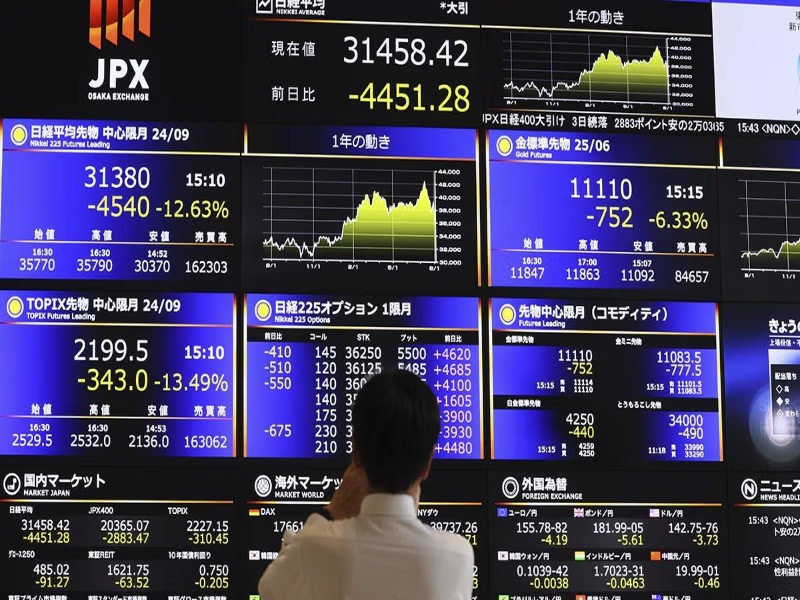
After the release of the data, the Nikkei 225 opened at an upsurge of 0.12 percent, yet the yen suffered a downgrading of 0.25 percent to 153.06 versus the dollar.
The Bank of Japan increased its economic growth outlook to 0.9 percent in January in the fiscal year ending March 2026, compared with its earlier forecast of 0.7 percent. It also boosted its fiscal 2026 projection to 1 percent, compared to 0.7 percent.
The central bank indicated that it is forecasting moderate growth since other nations will resume growth. The BOJ also noted that the economy has a virtuous cycle of the increase in prices and wages, which is supported by the economic measures of the government and the accommodative financial situation.
The figures also coincide with Japan negotiating with the U.S. second-largest trade partner, on a $550 billion investment commitment in its trade agreement with Washington.
Public broadcaster NHK stated last Friday that Tokyo and Washington have yet to agree on the first projects tied to the pledge.
Japan’s Economy Minister Ryosei Akazawa was quoted as saying that he hoped the first projects would be completed by the time Prime Minister Sanae Takaichi visits U.S. President Donald Trump.
Trump had announced the meeting with Takaichi just before the February 8 Lower House election, which witnessed Takaichi lead the ruling Liberal Democratic Party to a landslide victory.
Since her win, Takaichi said last Monday that she would support economic expansion by increasing investment through “proactive” fiscal policy, although she did not specify.
Therefore, she previously promised to abolish taxes on food for over two years and increase defence expenditure to 2 percent of the country’s budget.
Bruce Kirk, Chief Japan Equity Strategist and managing director at Goldman Sachs, added that defense will be the next major catalyst driving Japanese equities higher.
In an interview with CNBC Squawk Box Asia, Kirk mentioned the upcoming meeting of Takaichi with Trump, stating that he anticipated a spurt of announcements of Japanese and U.S. businesses regarding industrialization, factory automation, and shipbuilding.
Kirk also underscored a document issued by the Trump administration over the weekend that demanded U.S. reinvestment in maritime dominance and boasted of collaboration with Japan and South Korea in resurgent shipbuilding.
Takaichi had previously declared a record 122 trillion yen budget in the fiscal year beginning April 1, a second consecutive year of record spending, and a promise to contribute to households facing cost-of-living pressures.
Inflation in Japan had sharply declined in January to 2.1 percent, the lowest since March 2022. Thus, the prices have not dropped below the 2 percent target set by the Bank of Japan after 45 consecutive months.