

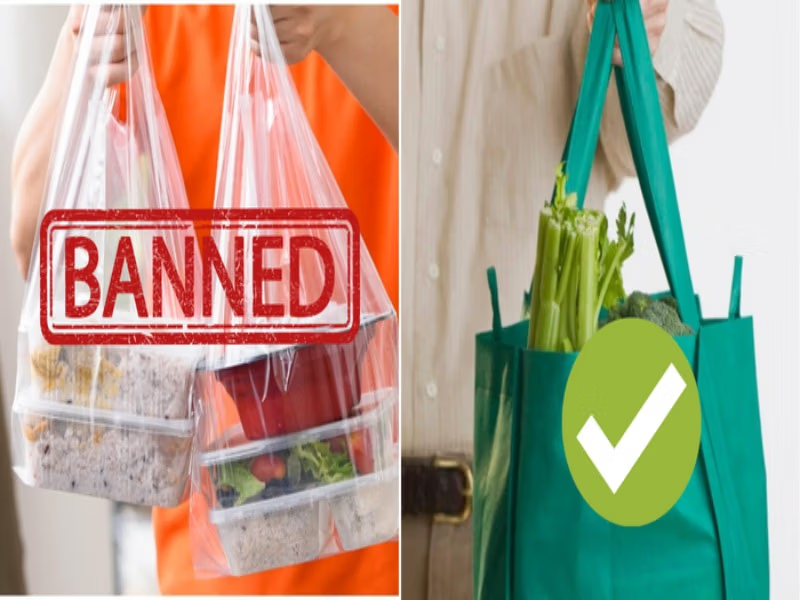
The Ministry of Climate Change and Environment (MOCCAE) has declared that the second phase of the Ministerial Decision No. 380 of 2022, which bans the importation, production, and sale of a wider variety of single-use consumer plastic products, along with bags. The action will become effective from January 1, 2026.
The move falls within the larger context of the environmental laws aimed at protecting the natural ecosystem of the UAE and reducing the environmental effects of waste in accordance with the strategic priorities of the country to promote its sustainability and improve the quality of life.
The Ministry has reported that the ban will be effective from January 1, which includes a defined range of single-use items, including beverage cups and lids; cutlery, such as spoons, forks, knives, and chopsticks; plates, straws, stirrers; and food containers and boxes made of Styrofoam.
The ruling also creates an all-encompassing prohibition on single-use bags, irrespective of their material composition, including paper, when their thickness falls below 50 microns. This will come into effect on the same day.
Assistant Under-Secretary for the Sustainable Communities Sector at the Ministry of Climate Change and Environment (MOCCAE), H.E. Eng. Alya Abdelrahim Alharmoodi said in a statement that the move to implement this decision is a pivotal one in the UAE’s movement towards a more sustainable future.
Alia Al Harmoudi said, “Regulating the use of single-use products is not only intended to reduce waste, but it is part of a comprehensive vision to advance the principles of the circular economy, in which resources are transformed into sustainable assets rather than environmental burdens.”
He added that “In the UAE, we adopt a balanced approach that prioritises the protection of marine and terrestrial environments from pollution risks, while simultaneously fostering business sustainability and growth.”
Alia Al Harmoudi stated, “We have confidence in the robust environmental awareness of the Emirati community and in the constructive cooperation demonstrated by the private sector, manufacturers and retailers in adopting sustainable practices and embracing environment friendly alternatives.”
He reported that “Protecting our environment is a shared responsibility, and every step taken to reduce the consumption of these products is an investment in the well-being of our society and the preservation of our natural landscapes.”
As part of its endeavor to ensure that trade flows smoothly and facilitates the industrial sector, the Ministry observed that the decision has particular exceptions.
They apply to the products that are produced to be exported, whereby production of prohibited products will be allowed on the basis that they are clearly marked for exportation or re-export outside the UAE, and they are not distributed in the local market.
Exemptions also apply to bags and products crafted of recycled goods in the UAE, to encourage and promote the local recycling industry.
Other exemptions will be medicine bags, refuse bags, very thin bags made of plastic to wrap fresh food products like meat, vegetables, and breads and large shopping bags that are supposed to be used to carry clothing products, electronics, and toys.
The Ministry encouraged every establishment, market, and supplier to adhere to the provisions of the decision entirely and actively work to promote the environmental objectives of the state.
The Ministry has been working in cooperation with its strategic partners in the various relevant authorities and entities nationwide to implement this decision in phases, with the first phase being activated on January 1, 2024.
However, this phase mandated the prohibition of the import, manufacture, and trade of all types of single-use plastic shopping bags, such as biodegradable plastic bags.
This action was a cornerstone of the UAE’s struggle to minimize the unnecessary use of single-use plastics and helped the community and markets shift to adopt sustainable and reusable products.