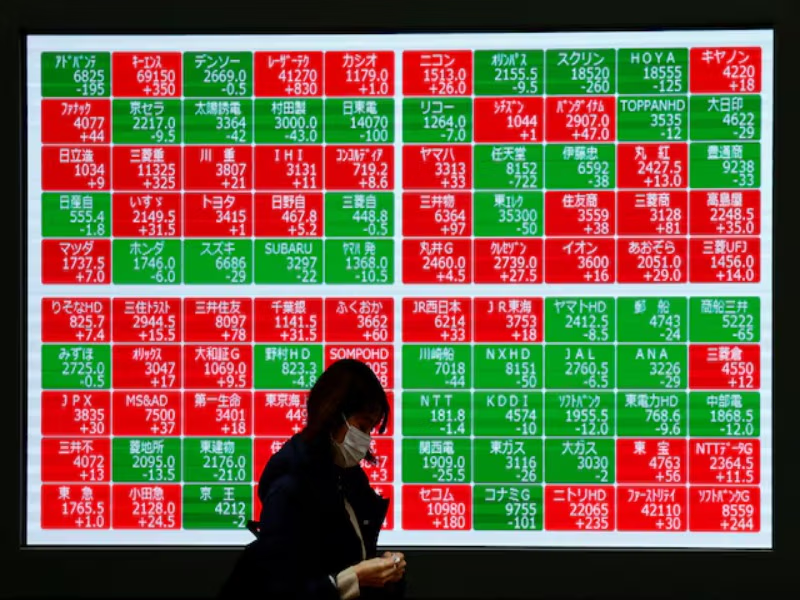
The Nikkei 225 of Japan reached a historic high of 58,000 on Thursday, extending its post-election run to new heights, as new confidence in domestic politics and the economic agenda of the ruling government rose.
The index benchmark then retreated profits and it was trading slightly above at 57,663. The broader Topix gained 0.68 percent.
The market watchers stated that the Japanese stocks have recorded a number of new highs in recent days, driven by the so-called “Takaichi trade,” after Prime Minister Sanae Takaichi won a landslide victory in the Lower House.
The global investment firm GMO indicated that Takaichi’s snap-election landslide gives her an unusually strong, multi-year mandate to execute policy, which they view as broadly supportive for Japan’s markets and corporate sector.
Although the rally in equities and the calming effect on bond investors suggest that the situation might be improving, the risk of intervention by GMO is increasing when the yen touches 160 against the greenback.
A stronger-than-expected U.S. payrolls report that has curtailed expectations of Federal Reserve rate cuts also shook off other markets in Asia as U.S. stocks slumped lower in the overnight market.
However, the Kospi of South Korea shot as high as 2.1 percent to an all-time high of 5,466.9 points, and retraced to close 1.82 percent. Small-cap Kosdaq was trading relatively flat.
Singapore’s benchmark index surpassed 5,000 for the first time. In the U.S., the Dow Jones Industrial Average broke a three-day winning streak overnight following an unexpectedly better-than-expected January jobs report.
Therefore, the blue-chip index declined 66.74 points or 0.13 percent and settled at 50,121.40. The S&P 500 was nearly flat at 6,941.47. The Nasdaq Composite fell by 0.16 percent to close at 23,066.47.
The Bureau of Labor Statistics’ January nonfarm payrolls report indicated job growth of 130,000 in January. Economists polled by Dow Jones had expected gains at 55,000. Job growth in December was downwardly revised to 48,000.
The robust labor market has minimized the chances of interest rate reduction by the Federal Reserve. The jobs report follows weaker-than-expected consumer data released on Tuesday. That report revealed that consumer spending in December was unchanged, compared to the gain of 0.4 percent a month as forecasted by those polled economists by Dow Jones.