
NVIDIA unveiled new open-source AI models, simulation tools, and datasets to accelerate the development of safer, reasoning-guided autonomous vehicles as competition intensifies.
It was introduced during the CES technology show. The Alpamayo family will target so-called “long-tail” driving situations, which are rare and complex, and which are one of the largest barriers to large-scale deployment of autonomous vehicles.
Traditional autonomous systems use independent perception and planning models, but this structure often fails when vehicles encounter new circumstances.
NVIDIA claimed the Alpamayo unveils reasoning-based vision language action (VLA) models that enable systems to reason step by step on cause and effect, enhance decision-making, safety, and explainability.
In a statement, NVIDIA founder and CEO Jensen Huang said, “The ChatGPT moment for physical AI is here, when machines begin to understand, reason, and act in the real world.”
He added that the technology would enable autonomous vehicles to manage the complex world and justify their choices when driving, which is a significant aspect of instilling trust and increasing deployment.
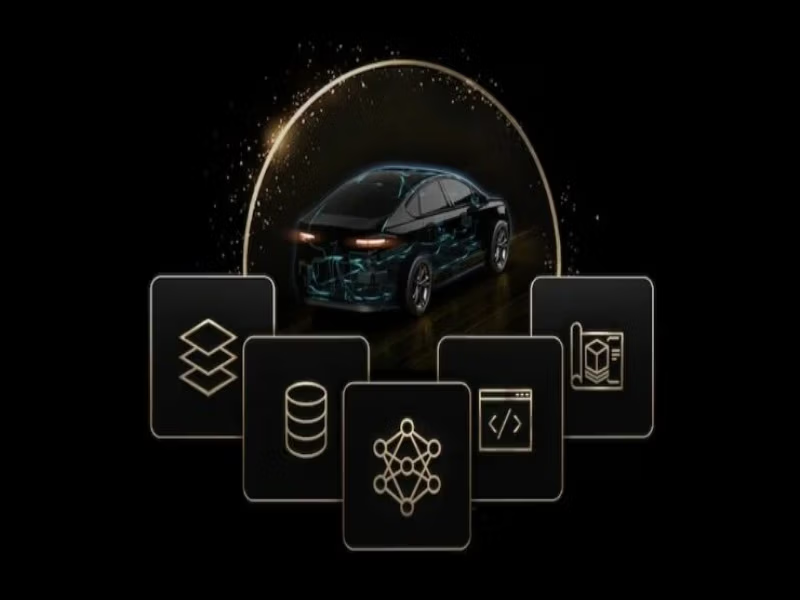
Therefore, the Alpamayo family integrates three components, including open AI models, simulation frameworks, and large-scale datasets. The models are not intended to be used directly within vehicles but instead serve as a “teacher” system, which developers can refine or reduce into smaller models applicable in real-world settings.
NVIDIA announced Alpamayo 1, a 10-billion-parameter chain-of-thought reasoning model to train autonomous driving research, and AlpaSim, an open-source autonomous driving research simulation platform.
The company is also availing physical AI open datasets of more than 1,700 hours of driving data recorded in various geographies and conditions.
The company claimed the tools would allow a self-reinforcing development loop so that developers could train, test, and refine reasoning-based autonomous driving systems in a more efficient way.
NVIDIA said that automotive and mobility companies, such as Jaguar Land Rover, Lucid, and Uber, and research groups, such as Berkeley DeepDrive, are evaluating the Alpamayo platform on their way to level 4 autonomy, where vehicles can operate without human intervention in specified environments.
It comes on a background of reduced advancement and increased questioning within the autonomous vehicle market, the firm noted that open development and enhanced rational abilities would enable the industry to overcome technical obstacles and scale to safer deployment.