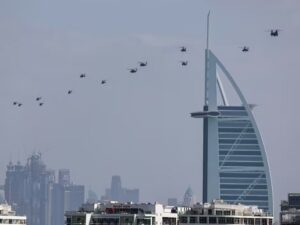

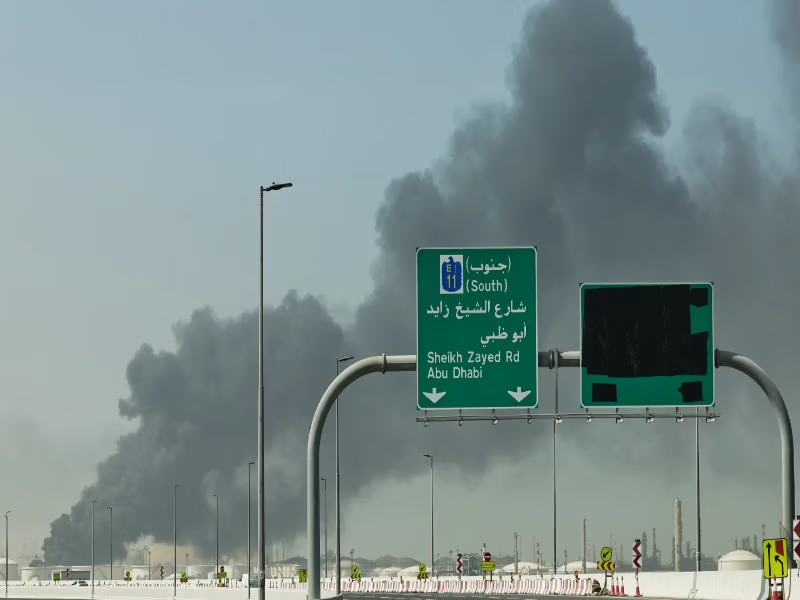
Big tech companies, among them Nvidia, Amazon, and Alphabet, are scrambling to focus on the safety of their workers who are traveling or residing in the Middle East following combined U.S.-Israel attacks on Iran over the weekend.
The massive attack on Iran resulted in the death of Supreme Leader Ayatollah Ali Khamenei, among others, and Iran responded by launching attacks on Israeli and U.S. bases in the Gulf. The war has upset the lives of the people, the internet in Iran, air travel routes, and oil exports in the region.
An email reviewed by CNBC, sent by CEO Jensen Huang to all employees on Tuesday morning, indicated that chip tech leader Nvidia had temporarily closed its Dubai offices, with employees there working remotely.
In his memo, Huang stated that Nvidia’s crisis management team has been “working around the clock and actively supporting affected employees and their families” in the Middle East, including approximately 6,000 Nvidia employees based in Israel.
Nvidia acquired Mellanox, an Israeli company in 2019 that produce ethernet switches and other networking hardware, for around $7.13 billion, the biggest deal in Nvidia’s history at that time. And nowadays, Israel is the other biggest research and development center of Nvidia outside the U.S.
Huang said that all the Nvidia workers who were affected by the dispute and their immediate family members were safe on Tuesday.
Huang wrote, “Nvidia has deep roots in the region. Thousands of our colleagues live there, and many more across the globe have family and friends affected by these events. Like you, I am watching with great concern for the safety of our Nvidia families.”
The State Department announced Monday that Americans should “depart now” from countries throughout the Middle East using existing commercial transportation, citing “serious safety risks.”
The agency indicated it was making efforts to evacuate the region using military aircraft and charter flights to evacuate Americans as instability continued to increase by Tuesday afternoon.
Sources reported that the air travel turbulences have left dozens of Google employees stuck in Dubai following a sales conference. The company’s cloud unit had its “Accelerate” sales kickoff in Dubai last week.
The employees stated that a memo was dispatched to some cloud workers on Sunday morning, citing that it is still has team members on the ground, adding that recent attacks are “concerning.”
Sources said that most employees escaped the region, but dozens of them are trapped there. After the Iran attack, there were massive cancellations among the airlines.
According to aviation-data firm Cirium, more than 11,000 Middle East flights have been cancelled since the U.S.-Israeli strikes over the weekend.
Google added that most of the affected employees are not U.S.-based but in-region employees. It also stated that it has security and safety protocols concerning its employees in the Middle East, and it has advised its staff to seek advice from local authorities.
A Google spokesperson said in an emailed statement, “The situation in the Middle East is evolving rapidly, and we are monitoring it carefully. Our focus is on the safety and well-being of our employees in the region.”
Dubai is also one of the regional centers of Google Cloud and sales in the Middle East and North Africa. Dubai’s Crown Prince Sheikh Hamdan bin Mohammed visited Google’s offices, exploring the company’s latest AI initiatives in the previous year.
Another center of Google is Tel Aviv, which is one of the central Israeli cities that has been hit by strikes. The search giant is also undergoing an expansion in a massive new headquarters in the ToHa2 Tower, which is likely to be one of its largest global locations.
Google was not that quick to act on inquiries concerning the impact of the Iran conflict on Tel Aviv-based operations and employees.
Amazon, which has increasingly expanded its operations in the Middle East region in recent years, is also changing its operations in the region, as it reacts to the escalating conflict in the region.
The company is instructing all of its corporate workers in the Middle East to work remotely and “follow local government guidelines.”
An Amazon spokesperson said in a statement, “The safety of our employees and partners remains our top priority, and we are working closely with local teams and local authorities to ensure they are supported.”
Amazon has corporate offices in the United Arab Emirates, Saudi Arabia, Jordan, Bahrain, Kuwait, Egypt, Turkey, and Israel. It also has warehouses and data centres all over the region and has Quick commerce outlets in the UAE to meet the 15-minute delivery demands.
Its vast footprint of data centers became the point of contention in the dispute on Sunday. Two facilities in the UAE were directly targeted by drones, and a facility in Bahrain was also impacted by a drone strike nearby.
The facilities resulted in structural damage, power disruptions, and some water damage after firefighters worked to put out sparks and fire.
The sites are still in the offline state, and certain Amazon Web Services applications, including its commonly-used virtual server and database services, have been reported to still have a problem.
AWS advised its customers to back up their data or think about migration of workloads to other regions.
AWS added, “Even as we work to restore these facilities, the ongoing conflict in the region means that the broader operating environment in the Middle East remains unpredictable.”
Social media company Snap informed CNBC that it is requesting employees in its four offices in the Middle East to work remotely until further notice.
The company indicated that staffers are being encouraged to adhere to the suggestions of local authorities when it comes to shelter-in-place orders and exit guidance.