
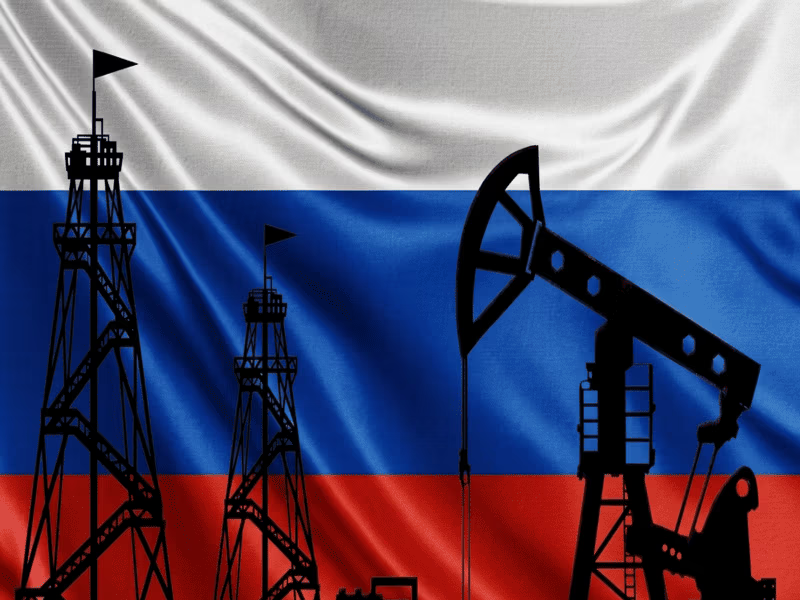
Oil prices were on track for weekly gains on Friday, even after the U.S. began to alleviate supply fears by issuing a 30-day license to countries to purchase Russian oil and petroleum products stranded at sea.
Brent futures for May might rise 10 cents, or 0.1 percent , to $100.56 a barrel by 0400 GMT, heading for about a 9 percent weekly gain. U.S. West Texas Intermediate (WTI) crude for April was down 16 cents, or 0.2 percent, at $95.57 a barrel, while poised for a 7 percent uptick for the week.
The license was granted in what Treasury Secretary Scott Bessent termed as an effort to stabilise world energy markets that have been shaken by the U.S.-Israeli war on Iran, but analysts indicated this has not helped in ensuring wider supply constraints.
Emril Jamil, Senior Analyst at LSEG, said “ICE Brent futures have already breached $100 per barrel and are still supported today, despite moves to calm the markets with the Russian oil waiver and the unprecedented release of emergency stockpiles.”
Jamil added, “The market sees this as a short-term solution that does not address the crux of the supply disruption. The crude intermonth spreads for future months indicate an unresolved and continued tightness in supply.”
Jamil stated that Brent is better supported than WTI because Europe is more vulnerable to energy security, whereas the U.S. can dodge its exposure owing to its domestic output.
Yang An, analyst at Haitong Futures, reported, “Issuing the license has eased market concerns, but it won’t resolve the most fundamental issue. The most important thing is the restoration of navigation in the Strait of Hormuz.”
The announcement on Russian oil followed a day after the U.S Energy Department stated the U.S. would release 172 million barrels of oil from its Strategic Petroleum Reserve to assist in curbing skyrocketing oil prices.
The International Energy Agency has coordinated that plan, which has agreed to issue a record 400 million barrels of oil from strategic stockpiles, including the U.S. contribution.
In a note, G analyst Tony Sycamore stated that fleeting relief intensified by the IEA release, caused by a re-escalation of Middle East risks. Both benchmark prices shot above 9 percent on Thursday and were at their highest levels since August 2022.
Iran’s new supreme leader, Mojtaba Khamenei, said that Iran would fight on and continue blockading the Strait of Hormuz as a bargaining leverage against the United States and Israel.
Iraqi security officials said on Thursday that two fuel tankers in Iraqi waters had been hit by Iranian boats loaded with explosives. An Iraqi official informed state media that the country’s oil ports have completely halted their operations.
Thus, U.S. Treasury Secretary Scott Bessent told Sky News in an interview that the U.S. Navy, with an international coalition, would escort ships across the Strait of Hormuz when it is militarily possible.