

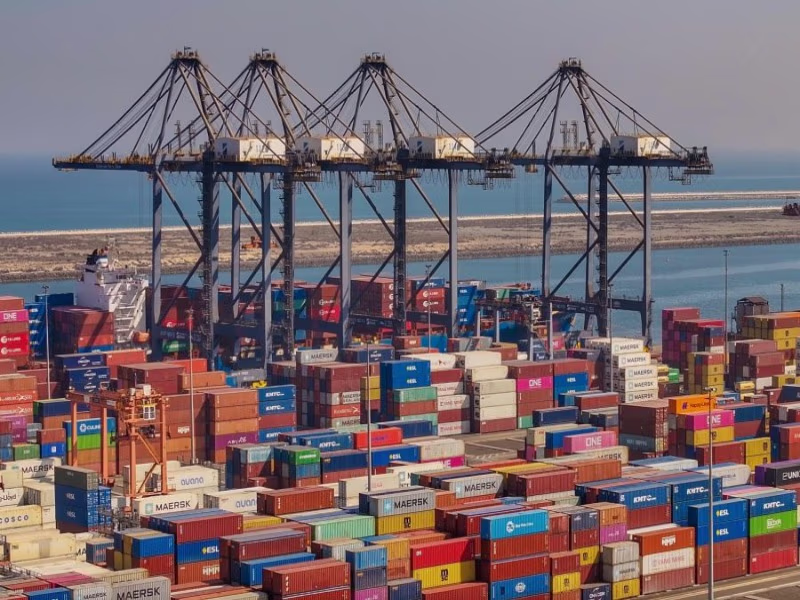
Non-oil exports increased by 7.5 percent to 6.7 billion Omani rials ($17.4 billion) in 2025, illustrating the growth in diversification despite overall export earnings being pulled down by lower crude prices.
According to the data from the National Centre for Statistics and Information, re-export activity was growing at a higher pace as it rose 20.3 percent year-on-year to 2.05 billion rials with the help of stronger trade flows via the ports and logistics centres of the Sultanate.
The growth will indicate the efforts by the government to increase industrial production and grow export-based industries because Oman strives to decrease its dependence on hydrocarbons as part of its economic diversification policy.
The non-oil trade has improved after Fitch Ratings, which in December granted Oman investment-grade status, increasing its long-term foreign-currency rating to BBB- instead of BB+.
The agency has mentioned the greater public finances, better external position, and still fiscal restraint with governmental debt decreasing to approximately 36 percent of gross domestic product in 2025 compared to approximately 68 percent in 2020.
Raymond Khoury, Partner and Public Sector Lead at Arthur D. Little Middle East, said, “The Sultanate of Oman has made notable advancements in diversifying its exports and enhancing its economy sustainably, particularly through non-oil sectors.”
He stated, “To build on this progress, it is crucial to increase investments in modern technologies like artificial intelligence, especially by establishing advanced data centers to support digital sovereignty and integrating AI into manufacturing and agriculture to boost productivity and further diversify the export portfolio.”
The new data also indicated that chemical and related industries, metal products, plastics, and machinery and electrical equipment were the most conspicuous Omani non-oil exports in the previous year.
The statistics also revealed a decrease in the worth of oil and gas exports, which went down to 14.5 billion rials, representing a 15.2 percent year-on-year decline.
The oil exports were affected by a fall in the average price of Omani crude to $71 per barrel in the previous year from $80.8 per barrel in 2024.
The overall oil exports in the previous year stood at 307.9 million barrels, compared with 308.4 million barrels in 2024, while average daily oil production surged from 992,600 barrels per day in 2024 to more than one million barrels per day in 2025.
It was also revealed that the value of merchandise exports of Oman was 23.2 billion rials last year, and this is a decrease of 7.1 percent of 2024, primarily because of the decrease in the revenues of oil exports.
However, the merchandise imports soared by 2.7 percent in the same year to surpass 17.1 billion rials in 2025. Statistics also showed that the total merchandise trade in Oman was 40.4 billion rials in 2025 compared with 41.7 billion rials in 2024, reflecting the reduced value of oil exports.
In terms of exporting merchants to non-oil, the UAE led the pack with over 1.31 billion rials in 2025, which is an increase of 25.3 percent year-on-year.
Omani non-oil exports to Saudi Arabia improved by 849 million rials to 1.07 billion rials within the same time, whereas exports to India went up by 6 percent to about 700 million rials. The non-oil exports to South Korea and the US declined by 26.1 percent and 13.3 percent, respectively.
The UAE was also the biggest re-export partner of Oman in terms of its share last year, contributing 35.2 percent of the total re-export trade of 2.05 billion rials. The value of goods re-exported to the UAE was 724 million rials, which witnessed an annual growth of 27.2 percent.
Iran came second with 365 million rials at a moderate growth of 1.6 percent compared to the previous year. The UK ranked third with 207 million rials, Saudi Arabia ranked fourth with 191 million rials, and India ranked fifth with 84 million rials.
The UAE has seen its merchandise imports grow by 5.4 percent in the year to a figure of over 4.1 billion rials. Chinese imports increased by 5.7 percent to 1.93 billion rials, whereas Indian imports decreased by 3.8 percent to 1.44 billion rials.
Thus, Kuwait imports dropped to 1.31 billion rials compared with 1.69 billion rials, and Saudi Arabia imports dropped to 1.21 billion rials compared with 1.28 billion rials.