
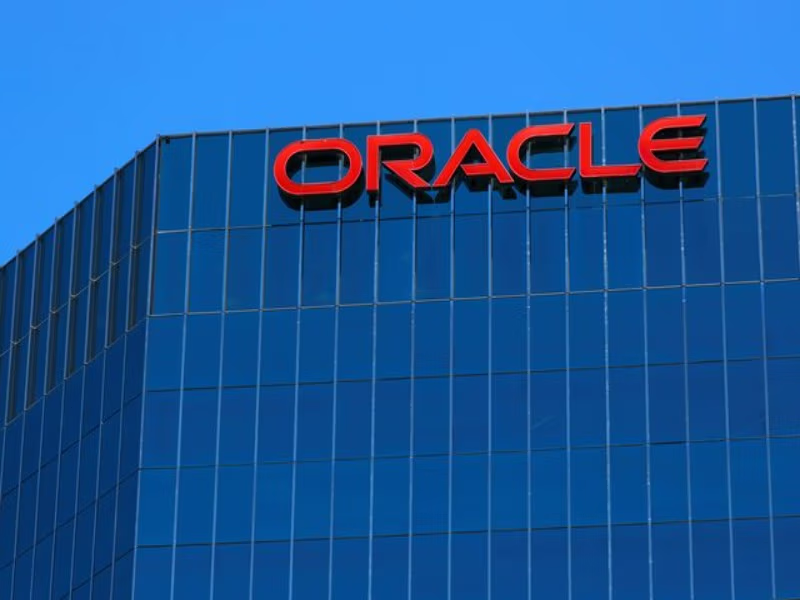
Oracle shares dropped 11 percent during extended trading on Wednesday following the database software maker’s report of lower quarterly revenue than expected in spite of soaring demand for its artificial intelligence infrastructure.
AI-related stocks were also hit after chipmakers Nvidia and Advanced Micro Devices each fell by 1 percent, and cloud provider CoreWeave down more than 3 percent.
The following are the results of Oracle compared to LSEG consensus: Earnings per share: $2.26 adjusted as compared to $1.64 expected. Revenue: $16.06 billion in comparison to. $16.21 billion expectation.
In terms of guidance, Oracle adjusted earnings per share to $1.70 to $1.74 and 19 percent to 21 percent revenue expansion for the fiscal third quarter. Therefore, the LSEG consensus involved $1.72 in earnings per share and $16.87 billion in revenue, a continuation of 19 percent growth.
According to a statement, Oracle’s fiscal second-quarter revenue extended up to 14 percent from the previous year in the quarter that ended November 30.
Net income, which had risen to $6.14 billion, or $2.14 per share, compared to $3.15 billion, or $1.13 per share, in the same quarter a year earlier. Adjusted earnings are in the exclusion of the stock-based compensation.
The company also reported that cloud revenue of $7.98 billion, which is higher than the $7.92 consensus, as estimated by analysts polled by StreetAccount. Cloud infrastructure revenue reached $4.1 billion, up 68 percent.
Therefore, the Oracle also highlighted to cloud business from Airbus, Canon, Deutsche Bank, LSEG, Panasonic, and Rubrik. Software revenue decreased by 3 percent to $5.88 billion, which is below the average analyst figure of $6.06 billion.
StreetAccount indicated that the remaining performance commitments, a contracted revenue measure that is yet to be registered, up 438 percent to $523 billion, which exceeds the average analyst’s forecast of $501.8 billion.
In the press release, Oracle’s Principal Financial Officer, Douglas Kehring, said that RPOs were driven “by new commitments from Meta, Nvidia, and others.” Kehring added that the company currently anticipates an extra revenue of $4 billion in fiscal 2027.
Oracle has spread its business operations beyond database and enterprise software to cloud infrastructure, where the company has competed with Amazon, Microsoft, and Google over the past decade.
All those companies are competing to acquire large AI contracts and are heavily investing in data centers and hardware that they will need to fulfill projected demand.
OpenAI, the company that catalyzed the generative AI boom with the release of ChatGPT three years prior, has committed to investing more than $300 billion in Oracle’s infrastructure services over five years.
The report by Oracle comes at a pivotal time for the company, which has been attempting to carve out a niche at the center of the AI market by investing in enormous build-outs.
Although the action has been optimistic for the revenue of Oracle and its backlog, the investors have become worried about the level of debt that the company is raising and the risks that it would encounter in the event that the momentum diminishes.
Therefore, in the earnings call of the company, Kehring promised to retain an investment-grade debt rating for Oracle.
Kehring said that “In addition, there are other financing options through customers that may bring their own chips to be installed in our data centers and suppliers who may lease their chips rather than sell them. Both of these options enable Oracle to synchronize our payments with our receipts and borrow substantially less than most people are modeling.”
Kehring stated that under the new agreements, Oracle could realize approximately $50 billion in capital expenditure per year, compared to $35 billion in September. The budget of fiscal 2025 was $21.2 billion.
The free cash flow of Oracle would be negative by an amount of $10 billion during the November quarter. The StreetAccount consensus was negative $5.2 billion.
Kehring added that “We’ve been reading a lot of analyst reports, and we’ve read quite a few that show an expectation of upwards of $100 billion for Oracle to go out and kind of complete these buildouts. And based on what we see right now, we expect we will need less, if not substantially less, money raised than that amount to go and fund this buildout.”
Oracle shares fell 23 percent in November, the lowest monthly decline since 2001. The stocks were down 32 percent at the end of the trading day on Wednesday, after being up 34 percent over the last year, compared to the Nasdaq, which has increased 22 percent over the same period.
Oracle named executives Clay Magouyrk and Mike Sicilia as the company’s new CEOs, succeeding Safra Catz, during the quarter. Oracle also launched AI agents to automate a number of aspects of finance, human resources, and sales.
Oracle reported that GAAP and adjusted earnings were affected by a pre-tax gain of $2.7 billion from the sale of chip designer Ampere, which Softbank had agreed to acquire at $6.5 billion in March. Oracle, which had been an investor in Ampere, claimed at the time that it would sell off its stake.
Chairman and Co-Founder Larry Ellison, reported in his statement that “Oracle sold Ampere because we no longer think it is strategic for us to continue designing, manufacturing and using our own chips in our cloud data centers. He said the company is “now committed to a policy of chip neutrality,” and will continue to buy the latest graphics processing chips from Nvidia, but needs “to be prepared and able to deploy whatever chips our customers want to buy.”