
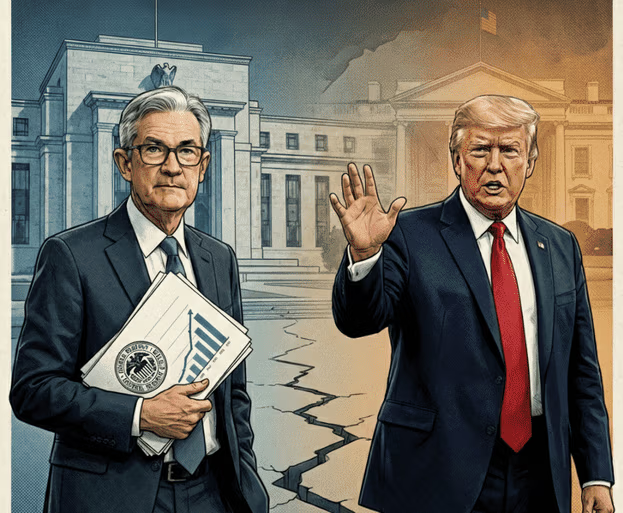
After months of deflecting criticism and avoiding direct confrontation with President Donald Trump, the Federal Reserve chair has drawn a sharp line in public. The shift comes as the U.S. Justice Department initiates a criminal probe into Powell, investigating whether he lied to Congress, an extraordinary escalation that has placed the full weight of the federal government behind a pressure campaign against the central bank.
For investors, policymakers, and global markets, the clash raises urgent questions: Is this a personal showdown, or a structural threat to U.S. monetary independence? And what happens to the Fed, and its credibility, if the conflict deepens?
In an unprecedented video message released Sunday night, Powell framed the moment as far bigger than himself.
“This new threat is not about my testimony last June or about the renovation of the Federal Reserve buildings,” Powell said in the video. “The threat of criminal charges is a consequence of the Federal Reserve setting interest rates based on our best assessment of what will serve the public, rather than following the preferences of the president.”
Powell described the investigation as a “pretext”, a vehicle, he argued, for undermining the Federal Reserve’s independence after it refused to align monetary policy with White House demands.
Appeasement, it appears, has failed. And now, the world’s most powerful central banker is fighting back.
A New Phase in the Powell–Trump Confrontation
The escalation marks a clear change, not just in the Trump administration’s tactics, but in Powell’s own posture.
For months, Trump and senior officials publicly criticized Powell, blaming him for high interest rates and signaling their desire for his removal. Until now, those attacks largely relied on rhetoric, pressure from the bully pulpit, and speculation about whether Powell would step aside voluntarily.
That calculus changed with the Justice Department’s decision to pursue a criminal probe.
Equally striking is Powell’s response. Throughout numerous Federal Open Market Committee press conferences, Powell consistently declined to engage, offering diplomatic non-answers and emphasizing the Fed’s nonpartisan mandate to pursue price stability and maximum employment.
With prosecutors now involved, Powell no longer appears willing, or able, to remain above the fray.
There are also implications for his future at the Fed. Powell’s term as chair expires in May, though his term as a Fed governor runs until 2028. Before this confrontation, it was widely assumed he might step away once his chairmanship ended, clearing the way for Trump to nominate a successor.
The legal pressure could change that. By staying on as a governor, Powell would deny Trump an immediate replacement opportunity and retain influence inside the institution while the investigation plays out. His invocation of public service in the video only adds to speculation that he may now be prepared to fight this battle to the end.
Is Fed Independence Now at Risk?
For Powell and his allies on Capitol Hill, the criminal probe represents something far more consequential than a personal legal challenge.
At issue is a foundational principle of modern economic governance: central bank independence.
If an administration can pursue criminal charges against Fed officials for interest-rate decisions it disagrees with, critics warn, the Federal Reserve risks becoming an extension of the executive branch. That, in turn, could undermine investor confidence, weaken the dollar’s credibility, raise inflation expectations, and erode the Fed’s ability to anchor markets during crises.
The concern is not theoretical. Independent central banks are widely credited, by institutions such as the International Monetary Fund and the World Bank, with delivering lower inflation and more stable growth over time. Political interference, by contrast, has often preceded currency instability and capital flight in emerging markets.
So far, markets have reacted cautiously. U.S. stocks and Treasury yields were largely steady on Monday, suggesting investors are waiting for clarity before repricing risk. But the timing is sensitive. With Powell nearing the end of his chairmanship, uncertainty over leadership and institutional integrity could begin to weigh on expectations.
The Shadow Over the Next Fed Chair
The fallout will not stop with Powell.
Whoever becomes the next Federal Reserve chair will inherit an institution under pressure, and a precedent that future administrations could attempt to influence monetary policy through legal or political threats.
That reality will loom large over the confirmation process.
Republican Senator Thom Tillis of North Carolina, who sits on the Senate committee overseeing Federal Reserve nominations, said he would seek to block all of Trump’s central bank nominees over the issue. Senator Lisa Murkowski of Alaska went further, calling the investigation “nothing more than an attempt at coercion” and endorsing Tillis’s blockade.
Even if confirmation hearings are delayed until the probe is resolved, any nominee will face scrutiny from multiple directions: accusations of being too close to the White House, concerns about defending Fed independence, and questions about whether the institution can withstand political pressure.
The scandal surrounding Powell will inevitably color those hearings, and shape how markets assess the Fed’s future credibility.
A Defining Moment for U.S. Monetary Power
At its core, the Powell–Trump standoff is not just about interest rates or personal rivalry. It is about whether the Federal Reserve can continue to operate as an independent steward of the world’s most important currency.
Powell has now made his case directly to the public. Whether Congress, the courts, and ultimately markets accept that argument may determine not only his legacy but the future balance between politics and monetary policy in the United States.