
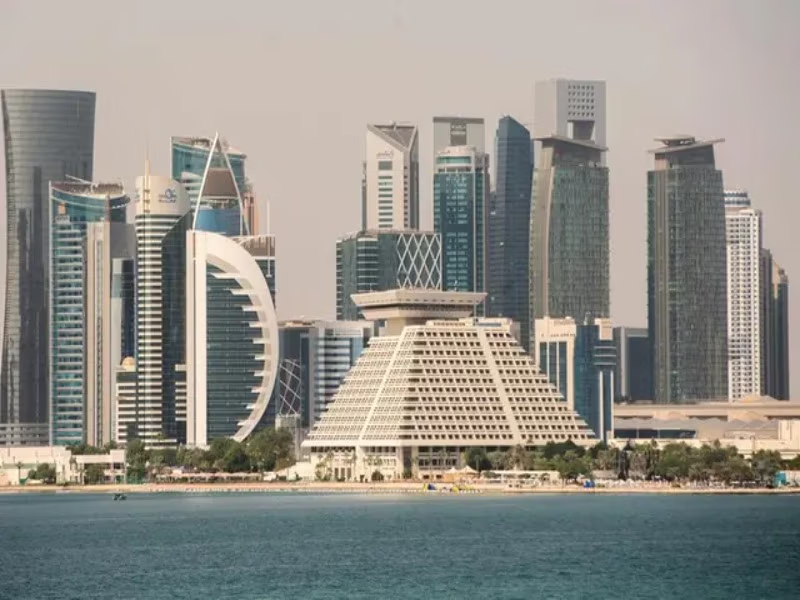
Qatar has introduced a number of major projects in the industrial sector this year that are expected to diversify the economy and enhance its sustainability and growth, following the National Vision 2030.
The Ministry of Commerce and Industry (MoCI) announced in a post on its X (formerly known as Twitter) that the milestones it has made towards 2025, as the Ministry launched various major strategic initiatives in 2020.
The initiatives are in line with Qatar’s aim to diversify its economy by not relying on oil and gas and developing a strong and competitive industrial sector that would lead to economic stability and development.
In terms of supporting the national industry, the post indicated that the contribution of the industrial sector to the GDP was QR27 billion, and the value of non-hydrocarbon industrial exports was QR29.8 billion.
In the same year, the National Product Platform was launched, and the number of national products grew to 2,135 in Q3 2025 compared to 2,015 products in Q3 2024. Therefore, the industries sector witnessed an increase in the number of factories, which in 2023 went up to 929, followed by 993 in 2024.
One of the major initiatives that was supposed to be used to support the national industrial sector is the National Product Week. It focuses on the quality of the Qatari products and increases their competitiveness in local and regional markets.
However, the post also emphasized the adoption of Qatari technical regulations on the shelf life of food products. The new regulation is meant to provide food products with safety and quality within the local market by implementing the shelf-life of the food products on sound scientific and current international standards.
This will aid in increasing consumer confidence and decreasing food wastage by implementing more lenient shelf-life based on dependable research, as well as fortifying the flexibility of the local market by permitting a broader and more varied array of products to be introduced.
The Ministry of Commerce and Industry has achieved successes that have helped in the improvement of the business environment, development of services, and the attraction of foreign investment. It also added that Qatar was among the top 10 countries in the world in the 2025 Global Competitiveness Report.
This success indicates that Qatar has a sufficient level of economic and administrative performance indicators and once again confirms the efficiency of the long-term national policies as the Third National Development Strategy is implemented and the national vision is achieved.
Qatar also ranked 5th in the world in terms of business efficiency. The first half of 2025 witnessed the establishment of 2,911 foreign companies in the country, which is a 163 percent growth compared to the previous year.
The Ministry’s Strategy 2024–2030 was developed directly on the basis of the objectives of the Third National Development Strategy and the relevant sectoral strategies, in line with the Ministry’s mandates.
The Ministry is undertaking 15 main initiatives through the National Manufacturing Strategy 2024-2030, which includes over 60 developmental projects to complement the efficiency of the industrial sector and invest in it.
The plan aims at increasing the contribution of the industrial sector to the Qatari economy, enhancing the value of non-hydrocarbon exports, and improving the positions held by Qatar’s position in the index of competitiveness of industries.
The National Manufacturing Strategy of Qatar, with its focus on sustainable development, economic diversification, and stimulation of the expansion of the small and medium-sized enterprises (SMEs), is all in line with the objectives of the National Vision 2030.
Thus, it seeks to make Qatar a global manufacturing excellence hub that will help in achieving long-term economic objectives in the country.