

Qatar Investment Authority (QIA) has taken part in a financing round of $500 million for Vast, a California-based company developing next-generation commercial space stations. Vast announced on Thursday that the financing is comprised of $300 million in Series A equity and $200 million in debt.
Balerion Space Ventures led the round, and the investors included IQT, QIA, Mitsui & Co, MUFG, Nikon Corporation, Stellar Ventures, Space Capital, Earthrise Ventures, and Vast founder Jed McCaleb.
McCaleb said, “Vast was founded with a long-term vision of billions of people living and thriving in space. Achieving a goal of this magnitude requires deliberate stepping stones, and our strategy of building, testing, and iterating with real hardware is delivering results.”
The sovereign wealth fund reported that the engagement of QIA is also indicative of its approach of collaborating with progressive companies in emerging sectors and extending capital on a long-term basis to speed up development, enhance technological innovation, and establish long-term value.
The mission of Vast is to make it possible to have humanity living and working in space in the long-term. The company plans to build low-earth orbit space stations, future habitats for the Moon and Mars, and crewed systems designed to extend the commercial space economy that will enhance the commercial space economy and also solidify partnerships and capabilities to support national defence goals.
Max Haot, CEO of Vast, stated, “This investment underscores the market’s strong conviction in both our strategy and our engineering. The low-Earth orbit economy is at a pivotal inflection point, poised for rapid growth. Vast’s Haven stations are engineered to deliver safe, cost-effective access to microgravity research and in-space manufacturing, empowering government and commercial partners to unlock the full commercial promise of this next era for space.”
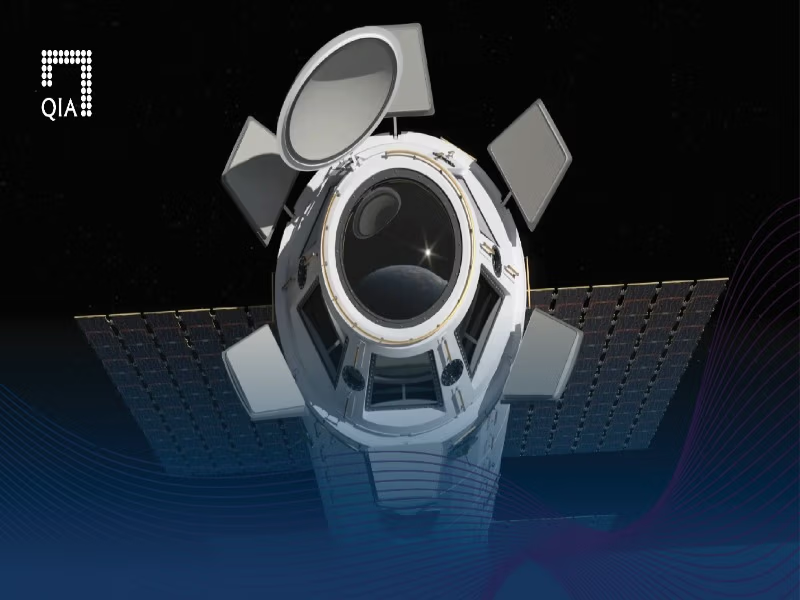
This funding will be directed towards the expansion and scaling of the team and development of Haven-2, a new successor to the International Space Station (ISS). Haven-2 is developed to help ensure a continuous human presence in low-Earth orbit for the US and its allies.
The company hopes to make Haven-1, a one-module space station, planned to be launched in 2027, the first commercial space station in the world, with more Haven modules making permanent human habitation a possibility by 2030.
The company successfully did the first launch of Haven Demo, a pathfinder spacecraft, in November 2025, and safely deorbited it in early 2026, after completing on-orbit tests.