
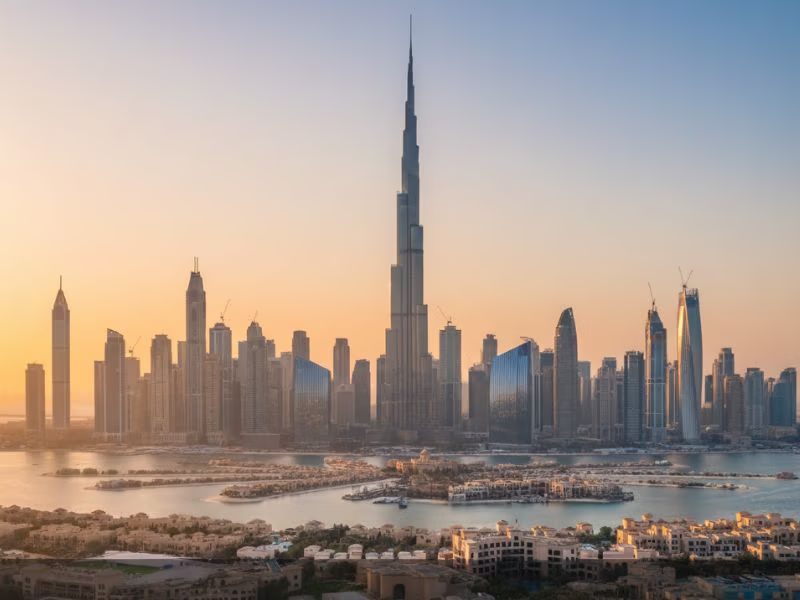
The UAE real estate market in 2025 has been shaped not just by trends but by specific communities and developments that exemplify sustainability, livability, and luxury. As the market heads into 2026, industry experts highlight how buyer preferences are evolving and what investors should watch in the coming year.
Key Developments of 2025
Nshama’s Town Square: “One of the strongest examples of sustainable, end-user–driven growth in Dubai. It consistently attracted first-time buyers and young families, driven by sensible pricing, functional layouts, schools, retail, and a genuine community feel. In a market often accused of chasing luxury headlines, Town Square quietly delivered volume, liquidity, and stability.”
Emaar’s The Valley: “Firmly established itself as a long-term suburban success story. It appealed to families upgrading from apartments and townhouses, as well as investors focused on predictable rental demand rather than short-term flips. Communities like this work because they are designed for how people actually live, not just how brochures look.”
Ultra-prime waterfront locations: “Canal Front, the so-called ‘Billionaire Row’, and early momentum around Palm Jebel Ali reinforced Dubai’s global luxury positioning. These areas weren’t about transaction volume; they were about signalling confidence, scarcity, and Dubai’s growing appeal to ultra-high-net-worth individuals globally,” Rohit Bachani, Co-Founder, Merlin Real Estate, identifies three communities that defined the market.
Experts believe, lifestyle-driven value creation and technology are expected to dominate. Zeeshaan Shah, Founder of ELEVATE, noted, “By the last quarter of a year, it becomes quite clear for our industry what the biggest trends will be to watch out for. Some big announcements in 2025 will also take bigger shape in 2026, for example, tokenization and a bigger, faster evolution of Proptech.”
Shah adds that developments in areas such as Al Marjan Island in RAK will increasingly focus on liveability and community appeal, “Investors and homebuyers are increasingly drawn to developments that combine strong liveability, community appeal, and experiential value alongside financial returns. Branded residences are gaining massive traction, as they bring global design standards and hospitality-led living into residential ownership.”
Wellness and Sustainability as Key Drivers
Wellness is no longer a “nice-to-have” but a core component of buyer demand. Shah explains, “Wellness has graduated from being a ‘nice-to-have’ amenity to a fundamental asset class. In 2026, a gym or a pool is no longer sufficient. Buyers are becoming hyper-aware of ‘Human Sustainability’; they are actively seeking environments that prolong their healthspan and combat modern urban fatigue.”
Developers are responding with ecosystems that promote physical, mental, and social well-being. “There is a noticeable shift beyond physical fitness to include mental and social well-being in residential developments. Buyers are increasingly willing to pay a premium for communities that foster genuine social connection. Homes that demonstrate a contribution to residents’ physical and mental longevity, while featuring thoughtful design and architectural quality, are expected to retain value most effectively.”
Bachani, meanwhile, also observes that wellness and sustainability have moved from buzzwords to buying filters and that buyers now actively look for green spaces, walkability, natural light, better air circulation, and layouts that support work-from-home living.
Developers are responding by creating integrated lifestyle ecosystems rather than standalone buildings. Buyers are willing to pay a premium for homes that reduce stress, not just square footage. The Emaar Valley is a prime example.
Moving on, the UAE real estate market is increasingly shifting from luxury- and asset-led development to a more disciplined, lifestyle-driven ecosystem. In 2026, quality, wellness, and community integration are set to define success, with developers and investors aligning with long-term trends in sustainable and experiential living.