
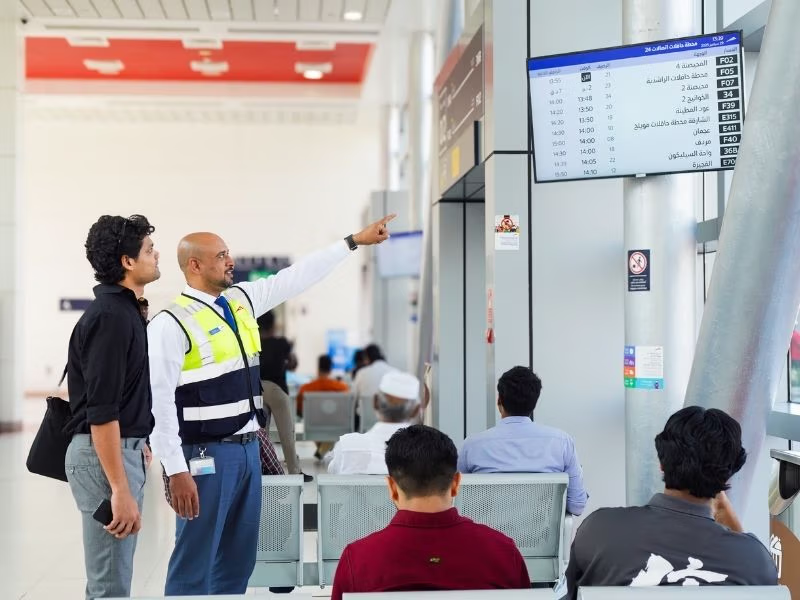
Dubai’s Roads and Transport Authority (RTA) has announced a significant leap in the performance of its bus operations, citing a 50% improvement in the punctuality index thanks to the strategic use of big data, artificial intelligence (AI), and continuous machine learning. The innovations come as part of RTA’s broader mission to make public transport in Dubai smarter, faster, and more sustainable, by leveraging real-time data, analytics, and automation across its network.
Marwan Al Zarooni, Director of Buses at RTA’s Public Transport Agency, highlighted several key outcomes: “Among the most notable achievements made was the bus punctuality index that had improved by more than 50% thanks to real-time re-engineering of operating schedules, complemented by the development of dedicated data-driven procedures to prevent buses from idling, thereby reducing carbon emissions.”
In addition to improved punctuality, RTA also recorded a 4% drop in trip cancellations, made possible by the deployment of advanced AI models. The application of artificial intelligence now plays a central role in maintaining operational continuity and improving passenger satisfaction.
Weather-Responsive Crisis Management
As part of its crisis and disaster management framework, RTA has also integrated a data-driven weather response mechanism, which enhances passenger safety during extreme weather events. These achievements have garnered notable recognition, including the “Top Participating Department” award in RTA’s 2024 Scientific Research Award. The department also received two first-tier research awards and had four research papers published in leading scientific journals.
“The responsible and innovative use of data is a central pillar of our smart management vision. These pioneering achievements demonstrate that artificial intelligence is no longer an experimental option but has become an active contributor to making Dubai’s bus network faster, more sustainable, and more reliable in meeting the needs of hundreds of thousands of passengers every day,” said Al Zarooni.
“Artificial intelligence has now evolved into a vital infrastructure that enables RTA to anticipate, adapt, and enhance the service for every passenger, ensuring that Dubai’s buses become smarter, faster, and more sustainable with each innovation.”
The RTA is not slowing down. According to Al Zarooni, the 2025–2030 roadmap is already in motion and includes:
Expanding predictive analytics
Introducing AI-supported driver training
Delivering customer service through AI platforms
Launching an open data platform to collaborate with academic and industry sectors
“The 2025–2030 roadmap includes the expansion of predictive analytics, the introduction of driver training supported by artificial intelligence, the provision of customer service through artificial intelligence, and the launch of an open data platform to foster innovation in partnership with academic and industry sectors,” he concluded.