
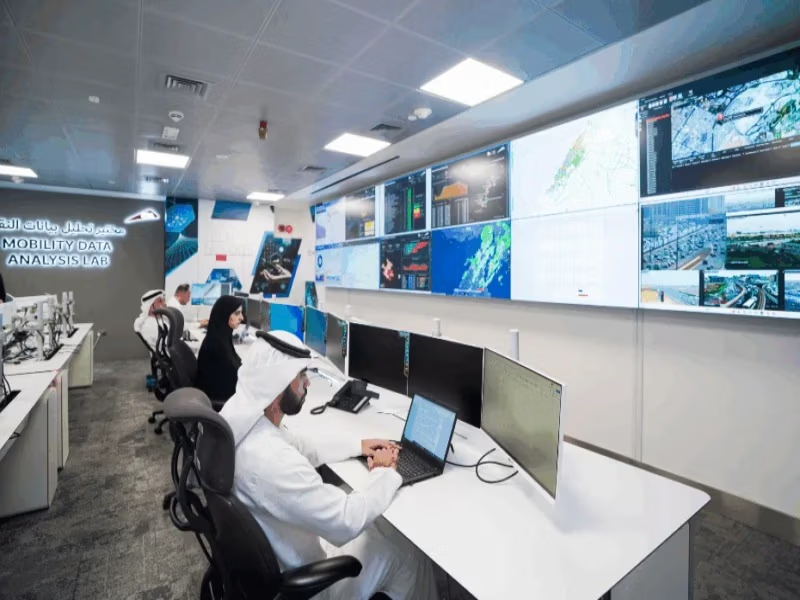
As a step to enhance the capability of Dubai in terms of transport planning, operational preparedness, and emergency response, Dubai Roads and Transport Authority (RTA) has opened a Transport Data Analysis Laboratory at its Enterprise Command and Control Centre (EC3).
The new laboratory will be used to track and gather transport data, and analyse it to generate specialized studies and reports that will facilitate decision-making processes at strategic and operational levels.
It also improves the readiness in major events and emergencies, grounding the status of Dubai as a smart city and a world leader in sustainable mobility.
The initiative also makes the Enterprise Command and Control Centre a higher plane of strategic platform where the control centers of RTA connect and manage.
The operational monitoring can be centralized to a single system to activate artificial intelligence technologies and predictive models to analyze the scenarios and provide proactive solutions, enhance performance, and decrease response times in case of major events and operational disruptions.
It is also in line with the future direction delivered by RTA as it provides personalized and data-driven transport services.
Director of the Enterprise Command and Control Center, Mohammed Al Ali, said that “The establishment of the Transport Data Analysis Laboratory represents a qualitative shift in the operational analytics ecosystem. It strengthens integration between monitoring systems and artificial intelligence and converts large volumes of operational data into predictive indicators that support accurate and rapid decision-making. These indicators contribute to smoother traffic flow, higher operational efficiency, and enhanced sustainability of the transport system across the emirate.”
He added, “This initiative represents a new step within RTA’s ongoing efforts to harness modern technologies in support of its vision for safe, seamless, and sustainable mobility, while reinforcing the role of the EC3 as a key hub for innovation and digital transformation within Dubai’s intelligent transport ecosystem.”
Al Ali stated that “The Transport Data Analysis Laboratory is supplied with real-time data from more than 35 sources covering various modes of transport, in coordination with operational centres and relevant departments. These include buses, the metro, the tram, marine transport, soft mobility means, as well as taxis, limousines, and private vehicles. The laboratory also automates more than 150 operational performance indicators, enhancing planning effectiveness, on-ground coordination, response speed, and the evaluation of implemented or pre-planned policies.”
Al Ali also observed that the laboratory is a practical way of transforming the vision of RTA into practice and enhancing research partnerships with academic institutions and strategic partners.
He further reported that “This is achieved through decision-making supported by an integrated framework focused on preparing comprehensive analytical studies and reports and leveraging artificial intelligence and big data to build advanced analytical models. These models contribute to forecasting traffic movement and demand levels across different modes of transport, thereby enhancing operational readiness under various times and conditions.”
However, the lab has already been implemented to examine the movement of transport in GITEX 2025. The Data Drive platform was utilized to compare traffic patterns during the event and before to determine areas of congestion and to enhance traffic flow throughout the exhibition area.
Therefore, the insights will be employed to ensure operational efficiency and guide planning of other large-scale events. The laboratory has also aided in the identification of locations where a recurrence of traffic accidents is more likely to occur through its advanced systems of analysis.
This makes it possible to undertake specific corrective actions in liaison with the concerned authorities and helps to make the roads in the Dubai road system safer and to move traffic more easily.